

Maximum Grades By Making ready With GH-900 Dumps UPDATED 2026
Prepare GH-900 Exam Questions [2026] Recently Updated Questions
NEW QUESTION # 58
What is GitHub?
- A. A proprietary software platform for nurturing creativity in developers and building a technology community
- B. A cloud-based hosting service for version control and collaboration, focused on creating a safe and collaborative environment for developers
- C. A platform that focuses on facilitating the growth and sharing of code, specifically designed for new developers to hone their skills
- D. A centralized version control system designed for nurturing a community of developers and providing access to open source projects
Answer: B
Explanation:
GitHub is a cloud-based platform that provides hosting for software development and version control using Git. It offers tools for collaboration, project management, and security to create a safe and productive environment for developers.
GitHub Overview:
Option B is correct because GitHub is primarily known as a cloud-based hosting service for Git repositories, offering a collaborative environment where developers can work together on projects, manage version control, and implement security practices.
Incorrect Options:
Option A is incorrect because GitHub is not proprietary in the sense of being closed off from version control standards; it is widely recognized as an open platform for collaboration.
Option C is incorrect because, while GitHub is accessible to new developers, it is designed for developers of all skill levels and not specifically tailored for beginners.
Option D is incorrect because GitHub is not a centralized version control system; it supports Git, which is distributed.
Reference:
GitHub Docs: About GitHub
NEW QUESTION # 59
If there are multiple README files, which of the following locations will be displayed first?
- A. Root
- B. .github
- C. /docs
- D. /src
Answer: A
Explanation:
When multiple README files exist in different locations within a GitHub repository, the README.md file located in the root directory of the repository will be displayed first by default. This file serves as the main documentation for the repository and is automatically rendered on the repository ' s home page.
* Root Directory:
* Option C is correct because the README.md file in the root directory is prioritized and displayed first on GitHub. This is the standard behavior for how GitHub presents documentation.
* Incorrect Options:
* Option A ( .github ) is incorrect because while a README.md file in the .github directory might be used for certain configurations, it is not the first to be displayed.
* Option B ( /src ) is incorrect because the README.md in the src directory is not prioritized over the root.
* Option D ( /docs ) is incorrect because documentation in the /docs folder is typically secondary to the root README.md .
References:
GitHub Docs: About READMEs
NEW QUESTION # 60
When using Organizations, GitHub Teams is better than GitHub Free because it offers:
- A. Advanced tools and insights in private repositories.
- B. Increased GitHub Actions minutes and additional GitHub Packages storage.
- C. Expanded storage and priority support.
- D. Authentication with SAML single sign-on and increased GitHub Actions minutes.
Answer: D
Explanation:
GitHub Teams, as part of GitHub's paid plans, offers additional features and capabilities compared to GitHub Free, particularly for organizations.
GitHub Teams Benefits:
Option B is correct because GitHub Teams provides advanced security features like SAML single sign- on for secure authentication, as well as increased minutes for running GitHub Actions, which are essential for continuous integration and deployment workflows.
NEW QUESTION # 61
Which of the following is a primary goal of GitHub ' s community?
- A. Exclusively supporting experienced developers
- B. Facilitating collaboration and creativity
- C. Creating a competitive environment for developers
- D. Enforcing strict code quality standards
Answer: B
Explanation:
GitHub ' s community is centered around enabling developers to collaborate and innovate together. The platform provides tools and environments that foster open communication, sharing of ideas, and collective problem-solving.
* Facilitating Collaboration and Creativity:
* Option C is correct because GitHub is designed to be a collaborative platform where developers can work together on projects, share code, and contribute to open source initiatives, all in an environment that encourages creativity.
* Incorrect Options:
* Option A is incorrect because GitHub is inclusive of developers of all skill levels, not just experienced ones.
* Option B is incorrect because GitHub is not about creating a competitive environment; rather, it focuses on collaboration.
* Option D is incorrect because while code quality is important, enforcing strict code quality standards is not the primary goal of the GitHub community.
References:
GitHub Docs: Building a Strong Community
NEW QUESTION # 62
What is GitHub?
- A. A proprietary software platform for nurturing creativity in developers and building a technology community
- B. A cloud-based hosting service for version control and collaboration, focused on creating a safe and collaborative environment for developers
- C. A platform that focuses on facilitating the growth and sharing of code, specifically designed for new developers to hone their skills
- D. A centralized version control system designed for nurturing a community of developers and providing access to open source projects
Answer: B
Explanation:
GitHub is a cloud-based platform that provides hosting for software development and version control using Git. It offers tools for collaboration, project management, and security to create a safe and productive environment for developers.
GitHub Overview:
Option B is correct because GitHub is primarily known as a cloud-based hosting service for Git repositories, offering a collaborative environment where developers can work together on projects, manage version control, and implement security practices.
NEW QUESTION # 63
What template types are available when creating an issue template? (Each correct answer presents part of the solution. Choose three.)
- A. Custom template
Bug report - B. Standard template
- C. Feature request
- D. Security notification
Answer: A,B,C
NEW QUESTION # 64
Which of the following are characteristics of GitHub Teams? (Each answer presents a complete solution.
Choose two.)
- A. Teams can be nested.
- B. Team visibility can be visible or secret.
- C. Teams has a maximum size of 100 users.
- D. Teams requires access to at least one repository.
Answer: A,B
NEW QUESTION # 65
Which of the following statements most accurately describes who can access a private repository Wiki?
- A. Wikis are public regardless of whether you have access to the repository.
- B. Wikis are only viewable by repository admins.
- C. Wikis can be viewed by the same people who have Read access to the repository.
- D. Wikis will not be visible until shared with a specific user.
Answer: C
Explanation:
For private repositories on GitHub, the Wiki is accessible to anyone who has Read access to the repository.
This means that if you can view the code and files in the repository, you can also view its Wiki. This makes Wikis a useful tool for documenting projects in a way that is available to all collaborators without requiring special permissions beyond those needed to access the repository itself.
NEW QUESTION # 66
How can a user create a repository template, and what permissions are required?
- A. With Maintain permissions, navigate to Organization settings, select the repository, and choose Template Repository.
- B. With Maintain permissions, navigate to Repository settings and select Template Repository.
- C. With Admin permissions, navigate to Repository settings and select Template Repository.
- D. With Admin permissions, navigate to Organization settings, select the repository, and choose Template Repository.
Answer: C
Explanation:
Creating a repository template in GitHub requires specific steps and permissions:
Creating a Repository Template:
Option A is correct because a user with Admin permissions can navigate to the repository's settings and enable the "Template Repository" option. This allows other users to generate new repositories from this template, which includes all branches, tags, and file history.
Other Options:
Option B is incorrect because "Maintain" permissions do not allow the creation of repository templates, and the option is not found in Organization settings but in the repository settings.
Option C is incorrect because the "Template Repository" option is in the repository settings, not in Organization settings.
Option D is incorrect because "Maintain" permissions do not grant the ability to create a repository template.
Reference:
GitHub Docs: Creating a Template Repository
NEW QUESTION # 67
An organization in a GitHub enterprise has a base permission of "No permissions." Which users in this enterprise will be able to see all internal repositories within this organization? (Choose two.)
- A. outside collaborators in the same organization
- B. members in the same organization
- C. outside collaborators with repo Admin access
- D. members in another organization in that enterprise
Answer: B,D
Explanation:
About internal repositories
If your organization is owned by an enterprise account, you can use internal repositories to practice "innersource" within your enterprise. Members of your enterprise can collaborate using open source methodologies without sharing proprietary information publicly.
All enterprise members have read permissions to the internal repository, but internal repositories are not visible to people outside of the enterprise, including outside collaborators on organization repositories.
Reference:
https://docs.github.com/en/enterprise-cloud@latest/repositories/creating-and-managing- repositories/about-repositories
NEW QUESTION # 68
Which of the following can be performed within GitHub Mobile?
- A. Chat with other GitHub Mobile users via voice calling
- B. Forking and cloning repositories
- C. Utilizing the mobile device as a self-hosted runner
- D. Managing notifications from github.com
- E. Managing enterprise and organization settings
Answer: D
Explanation:
GitHub Mobile provides a streamlined experience for managing your GitHub notifications and participating in discussions, but it does not offer full functionality compared to the desktop or web interface.
Managing Notifications:
Option E is correct because GitHub Mobile allows users to manage notifications, keeping them up to date with their repositories, issues, pull requests, and other activities on GitHub.
Incorrect Options:
Option A is incorrect because GitHub Mobile cannot be used as a self-hosted runner.
Option B is incorrect because managing enterprise and organization settings is not supported in GitHub Mobile.
Option C is incorrect because GitHub Mobile does not offer a chat or voice calling feature.
Option D is incorrect because forking and cloning repositories are not actions available in GitHub Mobile.
Reference:
GitHub Docs: GitHub Mobile
NEW QUESTION # 69
Which of the following items can you customize for an individual Codespace? (Choose three.)
- A. Shell
- B. Name
- C. Branch protections
- D. Default editor
- E. Operating system
Answer: A,B,D
Explanation:
When using GitHub Codespaces, you can customize several aspects of the development environment:
Shell: You can choose the default shell to be used in the Codespace, such as Bash, Zsh, or PowerShell.
Name: Users can customize the name of their Codespace for easier identification.
Default editor: You can choose which editor to use within the Codespace, such as Visual Studio Code or others that may be supported.
Branch protections and the operating system are not customizable for an individual Codespace within GitHub, making the options Shell, Name, and Default editor the correct answers.
NEW QUESTION # 70
Which of the following attributes are on the Milestone page? (Each correct answer presents a complete solution. Choose two.)
- A. each milestone ' s completion percentage
- B. a list of the open and closed issues associated with the milestone
- C. a summary list of GitHub Projects tagged to the milestone
- D. GitHub Action workflows that need to be executed to complete the milestone
Answer: A,B
NEW QUESTION # 71
You are part of a global development team working on a shared project. Some team members are offline or in different time zones. You want to ensure everyone can work independently while still contributing to the same codebase. You also want to maintain a full history of the project, including who made which changes and when. Which features or characteristics of Git support this collaborative workflow effectively? (Choose three.)
- A. Git allows developers to work independently using branchesright
- B. Git keeps a complete timeline of changes, including who made them and whyright
- C. Git requires a continuous internet connection to function correctly
- D. Git stores only the latest version of the code and discards historical data
- E. Git is a distributed version control system where each contributor has a full copy of the projectright
Answer: A,B,E
Explanation:
Git enables seamless collaboration by allowing developers to work independently using branches while maintaining a complete history of changes, ensuring transparency. Since Git is distributed, each contributor has a full copy of the repository, enabling offline work and eliminating reliance on a central server.
Option B is CORRECT because Branching lets developers work on different features or fixes simultaneously without interfering with the main codebase. Changes can be merged later when they are ready.
Option C is CORRECT because Git is a distributed version control system (DVCS). Every contributor has the entire project history locally, allowing them to work independently of others.
Option D is CORRECT because Git maintains a full history of all commits, tracking when changes were made, who made them, and often the reason behind them (through commit messages).
This provides transparency and accountability in a collaborative workflow.
Reference:
https://docs.github.com/en/get-started/using-git/about-git
NEW QUESTION # 72
What template types are available when creating an issue template? (Choose three.)
- A. Bug report
- B. Feature request
- C. Standard template
- D. Custom template
- E. Security notification
Answer: A,B,D
Explanation:
Configuring issue templates for your repository
You can customize the templates that are available for contributors to use when they open new issues in your repository.
Creating issue templates
1. On GitHub, navigate to the main page of the repository.
2. Under your repository name, click Settings. If you cannot see the "Settings" tab, select the dropdown menu, then click Settings.
3. In the "Features" section, under Issues, click Set up templates. You may need to enable Issues and refresh the page before you can see the button.
4. Use the Add template dropdown menu, and click on the type of template you'd like to create.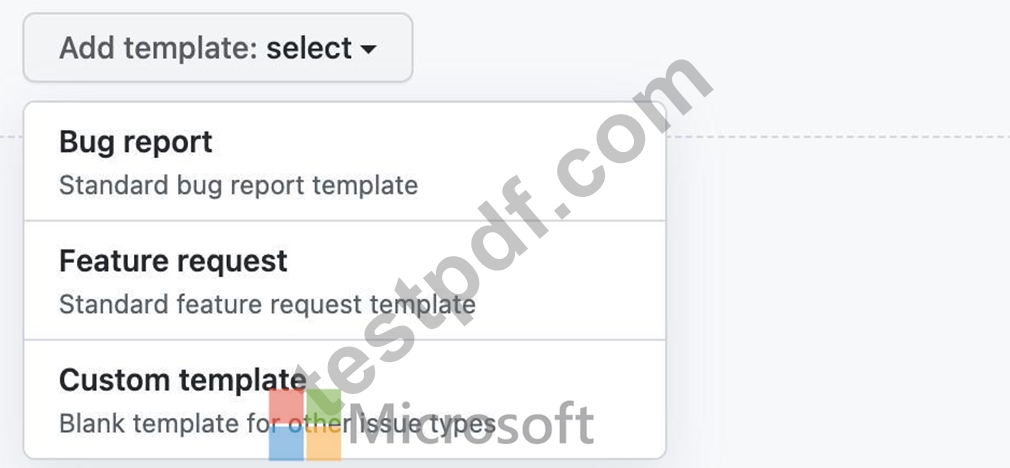
5. Etc.
Reference:
https://docs.github.com/en/communities/using-templates-to-encourage-useful-issues-and-pull- requests/configuring-issue-templates-for-your-repository
NEW QUESTION # 73
Which of the following types of charts can a user create to get GitHub Projects insights? (Each answer presents a complete solution. Choose two.)
- A. historical charts
- B. forecast charts
- C. current charts
- D. Gantt charts
- E. pie charts
Answer: A,C
NEW QUESTION # 74
Which syntax is used for authoring saved replies?
- A. Markup
- B. Markdown
- C. YAML
- D. HTML
Answer: B
NEW QUESTION # 75
Which of the following is the best description of a Git commit?
- A. a record of the most recent changes made by a developer in Git
- B. a log message that describes the purpose of the changes made to the files in a Git repository
- C. a snapshot of the entire repository at a specific point in time, capturing the state of all files in the project
- D. a series of changes made to a file, or set of files, in Git
Answer: C
NEW QUESTION # 76
What are all repository visibility options in GitHub Enterprise?
- A. public, internal, and private
- B. public, private
- C. external, private
- D. external, public, and private
Answer: A
Explanation:
Repository visibility
There are three visibility types for repositories: public, internal, and private.
Public repositories are visible to the world and are primarily used for open source content.
Internal repositories are read-accessible to all full members of your enterprise account (not to outside collaborators).
Private repositories are only visible to individuals or teams who have been given explicit access, including through enterprise or organization base permissions.
Reference:
https://resources.github.com/learn/pathways/administration-governance/essentials/manage-your- repository-visibility-rules-and-settings/
NEW QUESTION # 77
GitHub Actions workflows can be directly triggered by which of the following events?
(Each answer presents a complete solution. Choose three.)
- A. Adding a comment to a discussion post
- B. Committing a change to a local git repository
- C. Pushing to a GitHub repository
- D. Disabling a GitHub runner
- E. Creating an Issue
- F. Creating a new repository
Answer: A,C,E
Explanation:
GitHub Actions are automated workflows that can be triggered by various events on GitHub. Some common events that trigger workflows include pushes to a repository, creation of issues, and comments on discussion posts.
* Triggering GitHub Actions:
* Option D (Pushing to a GitHub repository) is correct because this is one of the most common triggers for CI/CD workflows.
* Option F (Creating an Issue) is correct because issues are commonly used as triggers for workflows, such as automatically assigning a label or notifying a team.
* Option A (Adding a comment to a discussion post) is correct because actions can be triggered by activity on discussion posts, including comments.
* Incorrect Options:
* Option B (Creating a new repository) is incorrect because this action typically does not trigger workflows within a specific repository.
* Option C (Committing a change to a local git repository) is incorrect because GitHub Actions are triggered by events on the GitHub platform, not by local commits.
* Option E (Disabling a GitHub runner) is incorrect because it is related to the environment where actions are executed, not a trigger for workflows.
References:
GitHub Docs: Events That Trigger Workflows
NEW QUESTION # 78
From the Organization settings, which restrictions can organization owners place on GitHub Actions usage? (Choose three.)
- A. Allow actions that use self-hosted runners.
- B. Allow an action to be run from a Codespace.
- C. Allow actions by Marketplace verified creators.
- D. Allow actions created by GitHub.
- E. Allow specified actions.
Answer: A,C,E
Explanation:
Organization owners on GitHub have control over how GitHub Actions can be used within their organization. They can enforce restrictions to ensure security and compliance with organizational policies.
Allow Actions That Use Self-Hosted Runners:
Option A is correct because organization owners can configure the usage of self-hosted runners, allowing greater control over the environment where actions are run.
Allow Specified Actions:
Option C is correct because organization owners can allow only specific actions to run, adding a layer of security by limiting actions to those that have been vetted.
Allow Actions by Marketplace Verified Creators:
Option D is correct because organization owners can choose to allow actions created by GitHub Marketplace verified creators, ensuring that only trusted actions are used.
NEW QUESTION # 79
......
Give push to your success with GH-900 exam questions: https://pass4sure.testpdf.com/GH-900-practice-test.html
