

Get Instant Access of 100% Real Nutanix NCP-EUC Exam Questions with Verified Answers
Exam Dumps for the Preparation of Latest NCP-EUC Exam Questions
Nutanix NCP-EUC exam is a valuable certification for IT professionals who work with Nutanix solutions. It covers a wide range of topics related to end-user computing, and validates the candidate's expertise in deploying and managing VDI solutions. Nutanix Certified Professional - End User Computing (NCP-EUC) 6.10 Exam certification is highly valued in the IT industry and can help IT professionals advance in their careers.
The NCP-EUC certification exam is specifically designed to assess an individual's knowledge of Nutanix's VDI solutions, including the installation, configuration, and management of these solutions. NCP-EUC exam is designed to test the candidate's ability to troubleshoot issues that may arise during the implementation and management of Nutanix's VDI solutions.
NEW QUESTION # 24
In a VMware Horizon environment running on Nutanix, an administrator has noticed that create, start, shut down, and delete operations are taking longer than expected, the environment is currently configured with one vCenter instance and has 10,000 virtual desktops. What is the recommended number of vCenter instances in this configuration?
- A. 0
- B. 1
- C. 2
- D. 3
Answer: C
Explanation:
vCenter can execute approximately 640 concurrent operations before incoming requests are queued, and can support up to 2,000 concurrent sessions1. VMware Horizon 8 can support up to 120,000 active sessions in a Cloud Pod Architecture pod federation23. Therefore, if the environment has 10,000 virtual desktops, one vCenter instance might not be enough to handle all the operations and sessions efficiently. The recommended number of vCenter instances in this configuration is B (2).
NEW QUESTION # 25
An administrator supports a user group that spans across 10 Nutanix clusters for a medium-sized medical communications firm. The 10 Nutanix clusters are managed by a single Prism Central instance.
This group's virtual desktops are all cloned from a common gold image and all applications are published from a Citrix Virtual Apps farm. The administrator needs to keep the gold image in sync across all of the clusters.
What is the best way to achieve this?
- A. use the native replication facility within the Machine Catalog
- B. use Move to maintain all gold images across the clusters.
- C. Setup a Protection Domain with the gold image as 3 protected entity.
- D. Upload the gold image to Prism Central Image Service.
Answer: D
Explanation:
Prism Central Image Service allows you to upload and manage images through Prism Central by using the v3 API. You can also choose where your images will be available across different clusters123
https://next.nutanix.com/ncm-intelligent-operations-formerly-prism-pro-ultimate-26/prism-central-adding-image
NEW QUESTION # 26
An administrator is tasked with enabling security measures through a STIG to ensure the CVM meets company requirements.
Which RHEL STIG version is the Nutanix CVM compliant with?
- A. RHEL 8 STIG
- B. RHEL 9 STIG
- C. RHEL 6 STIG
- D. RHEL 7 STIG
Answer: A
Explanation:
Comprehensive and Detailed Explanation From Exact Extract of Nutanix End User Computing documents:
According to the latest Nutanix Security Guide (AOS 6.x and later) regarding SCMA (Security Configuration Management Automation):
* OS Evolution: Modern Nutanix Controller VMs (CVMs) in current Long Term Support (LTS) releases (AOS 6.5 and above) utilize an operating system based on RHEL 8 / CentOS 8.
* STIG Compliance: Consequently, the built-in SCMA policies are updated to check and enforce compliance against the RHEL 8 STIG (Security Technical Implementation Guide).
* Correction Note: Older documentation (AOS 5.x) referenced the RHEL 7 STIG. However, per your request for "latest knowledge" applicable to current supported environments, the CVM is compliant with RHEL 8 STIGs. If this question appears on a legacy exam version, the answer might still be listed as C (RHEL 7), but B is the technically correct answer for modern Nutanix software.
NEW QUESTION # 27
A Windows IO VM fails to power on With an NVIDIA vCPU profile in ESXi 7. The VM is configured with NVIDIA profile by selecting Shared PCl Device, adding the NVIDIA GRID vCPU device. and selecting the Profile under VM settings.
The following error message is displayed in the vSphere web client: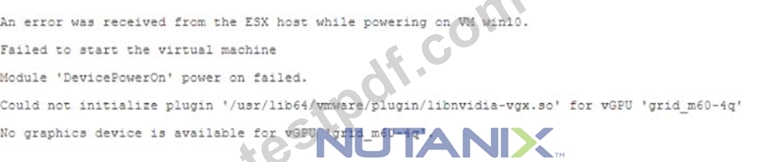
What should be done to resolve this issue?
- A. change the Graphics mode of the host from Shared Direct to Shared.
- B. Switch the GPU mode to compute mode using gpumodeswitch command.
- C. Change the Graphics mode of the host from Shared to Shared Direct
- D. Switch the GPU mode to graphics mode using gpumodeswitch command.
- E. Change the Graphics mode of the host from Shared to Shared Direct
Answer: D
Explanation:
gpumodeswitch is a command-line tool that is used to switch supported NVIDIA GPUs between compute and graphics mode. Compute mode allows multiple VMs to share a GPU for CUDA workloads. Graphics mode allows a single VM to use a GPU for graphics workloads12.
NEW QUESTION # 28
An administrator has a 3-node ESXi-based Nutanix cluster where one host has an NVIDIA GPU installed.
The administrator is planning to perform an ESXi upgrade using Nutanix Life Cycle Manager (LCM) and requires the NVIDIA vGPU-enabled VM to remain online throughout the maintenance window.
What should the administrator do to successfully complete this task?
- A. Configure VMware HA and DRS.
- B. Hot-swap the GPU between hosts.
- C. Temporarily disable the vGPU.
- D. Install a GPU in a second host.
Answer: D
Explanation:
Comprehensive and Detailed Explanation From Exact Extract of Nutanix End User Computing documents:
According to Nutanix LCM and NVIDIA vGPU operational best practices:
* Live Migration Requirement: To keep a VM "online" during a host upgrade, the VM must be live- migrated (vMotioned) off the host entering maintenance mode.
* vGPU Constraint: A VM configured with a vGPU profile cannot be live-migrated to a host that does not have a compatible physical GPU resource available.4 The destination host must have a GPU capable of hosting the specific vGPU profile.
* The Solution: Since only one host currently has a GPU, there is no valid destination for the VM to migrate to. The administrator must install a GPU in a second host to create a valid migration target.
This allows the VM to vMotion to the second host, keeping it online while the first host is upgraded.
NEW QUESTION # 29
The deployment of a new desktop from a Citrix PVS snapshot template is failing. While investigating, the administrator finds that the creation of the VM's write-cache disk failed.
What is a possible cause of this failure?
- A. The VM template snapshot has a virtual disk attached.
- B. The VM template is configured with a SATA disk controller.
- C. The VM template does not have a virtual NIC configured.
- D. The VM template has a CDROM drive provisioned.
Answer: A
Explanation:
In a Nutanix AHV environment integrated with Citrix Provisioning (PVS), the XenDesktop Setup Wizard (or Citrix Virtual Desktops Setup Wizard) is responsible for creating the Write Cache disk for target VMs during the provisioning process.
According to Nutanix Knowledge Base articles regarding PVS on AHV, a common cause for the failure of the write-cache disk creation is the presence of an attached virtual disk on the snapshot used as the template. The wizard expects to create and attach the write-cache disk itself. If the template snapshot already has a hard disk attached (other than the potential CD-ROM, which is generally supported if single), the wizard's logic for disk slot assignment or disk creation conflicts with the existing disk, causing the "creation of the VM's write-cache disk failed" error. The supported procedure explicitly states that the VM template snapshot must be created without any hard disks attached.
NEW QUESTION # 30
An administrator is required to keep past custom reports. The report runs once daily. Last Friday, when the administrator checked, there were 22 copies saved. On Friday this week, an administrator expects to see 29 saved report copies, but some reports are missing.
What is a probable cause?
- A. The system currently has retained the maximum of 25 copies.
- B. The system reached the default retention policy limit.
- C. Time-based retention reached the maximum of 2 months.
- D. PC has migrated to another system and all reports are not visible.
Answer: A
Explanation:
In Nutanix Prism Central, the reporting feature allows administrators to schedule and generate custom reports.
To manage storage and database capacity, Prism Central enforces a retention limit on these generated report instances.
According to the Prism Central Guide, "By default, Prism Central retains 25 instances of each report." In the scenario described:
* The administrator had 22 reports.
* Over the next week (7 days), 7 new reports were generated (22 + 7 = 29 total potential instances).
* Because the total (29) exceeds the hard default limit of 25, the system automatically rotated out (deleted) the 4 oldest copies to maintain the count at 25. This explains why reports are missing despite the expectation of seeing 29.
NEW QUESTION # 31
A network team is designing a new switch infrastructure and wants to keep VM traffic and Storage resiliency traffic separate while minimizing the number of physical ports in use on the switch.
What best practice design choice will work?
- A. Use the native VLAN for CVMs and tagged VLAN for VMs
- B. Connect breakout cables to multiple node interfaces
- C. Configure traffic shaping to distribute traffic between VLANs
- D. Separate CVM and VM NICs in different virtual switches
Answer: A
Explanation:
To achieve logical traffic separation while minimizing physical ports (using the same physical uplinks for multiple traffic types), Nutanix AHV networking best practices recommend the use of 802.1Q VLAN tagging.
The standard validated design is to:
* Place the CVM and AHV Host management/storage interfaces on the Native VLAN (untagged) or a specific management VLAN.
* Place User VM (Guest) traffic on Tagged VLANs.
This configuration allows storage replication traffic (CVM) and user traffic (VMs) to share the same physical cables (minimizing port usage) while remaining logically isolated at the switch level. Options like separate virtual switches (Option B) often require dedicated physical uplinks, which violates the requirement to minimize ports.
NEW QUESTION # 32
An administrator has been evaluating a performance issue with the current Citrix VD' solution on Nutanix.
During the evaluation, the administrator finds out there is a feature that is enabled called Shadow Clones.
What would happen if an administrator disabled Shadow Clones within a company's VDI environment?
- A. Deployment times would increase as the number deployed desktops increase,
- B. Deployment times would decrease when deploying additional desktops.
- C. Boot storms would be eliminated because the number of desktops would be throttled.
- D. Boot storms would be eliminated due to desktop resource contention.
Answer: A
Explanation:
Nutanix's Shadow Clones feature is used to create linked clones or snapshots of base VMs, which can improve VM provisioning time and storage efficiency by reducing the amount of duplicated data.
If an administrator disables Shadow Clones within a company's VDI environment, it is likely that deployment times would increase as the number of deployed desktops increases. This is because linked clones or snapshots would no longer be used, so each new desktop deployment would require creating a full copy of the base VM.
Nutanix Shadow Clones allow for distributed caching of a particular disk or VM data, which are in a
'multi-reader' scenario. This can help in scenarios such as VDI or private clone boot storms, where VMs on multiple nodes read from the same set of base disks12
NEW QUESTION # 33
A company has decided to use Citrix Optimizer tool to prepare their gold image.
Which two actions does Optimizer take to improve the gold image creation process? (Choose two.)
- A. Applies best practices for securing virtual desktops.
- B. uses built-in templates to perform optimizations.
- C. Optimizes user environments for better performance
- D. Optimizes storage capacity usage.
Answer: B,C
Explanation:
The Citrix Optimizer tool is used to prepare Windows operating system images for use in a virtual desktop environment. Some of the actions that it takes to improve the gold image creation process include:
Optimizes user environments for better performance: The tool removes unnecessary or redundant services, features, and applications from the image, which can improve performance and reduce resource usage.
Uses built-in templates to perform optimizations: The tool comes with pre-configured templates that are optimized for specific environments, such as virtual desktops or server workloads. These templates can be customized based on the specific needs of the organization.
https://support.citrix.com/article/CTX224676/citrix-optimizer-tool
https://docs.citrix.com/en-us/workspace-environment-management/service/using-environment-management/system-optimization/citrix-optimizer.html
NEW QUESTION # 34
By default, Prism Central provides 18 predefined system report configurations that address common use cases and requirements of an organization's infrastructure management.
What is a valid action for predefined report configurations?
- A. Delete
- B. Export
- C. Edit
- D. Schedule
Answer: D
Explanation:
According to the Prism Central Guide regarding Reporting, predefined system reports (such as Cluster Efficiency, Environment Summary, etc.) are built-in templates provided by Nutanix. The documentation explicitly states that while administrators can view and run these reports, they cannot delete or modify (Edit) the structure of these predefined reports directly.
However, the valid action an administrator can perform on a predefined report is to Schedule it. Scheduling allows the report to run automatically at specified intervals and email the results to recipients. If modification is required, the administrator must first clone the predefined report to create a custom copy, which can then be edited; the original remains locked.
NEW QUESTION # 35
The administrator has checked the logs to see the below output:
The API call sent to the VM via XD Plugin at [CDF logs]: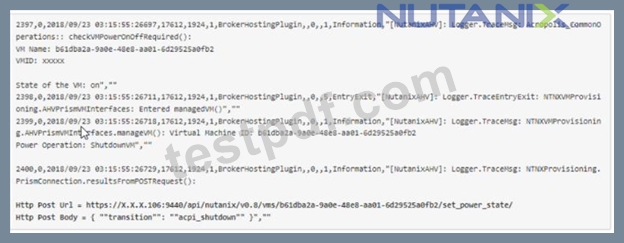
Following that while the VM is being powered OFF, query for the current VM state results in ON (the administrator sees a number of these until the VM is marked as power OFF) logs]: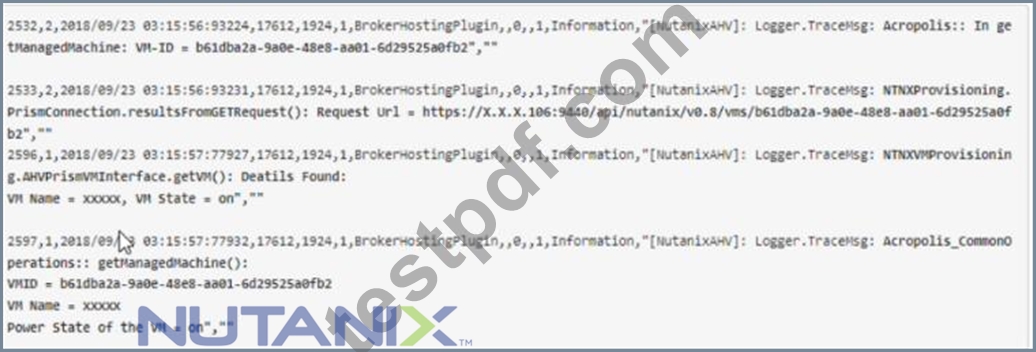
Upon further review the administrator notices in COF logs, after a number of queries for the machine state, one results in a conflicting state, reporting the Power state as ON anc OFF [CDF logs) HCM should the administrator resolve the issue?
- A. Delete Scheduled reboot settings
- B. Create a Scheduled reboot cycle.
- C. Decrease the distribution time in Machine Update Rollout
- D. Increase the distribution time in Machine Update Rollout
Answer: B
NEW QUESTION # 36
Refer to the exhibit.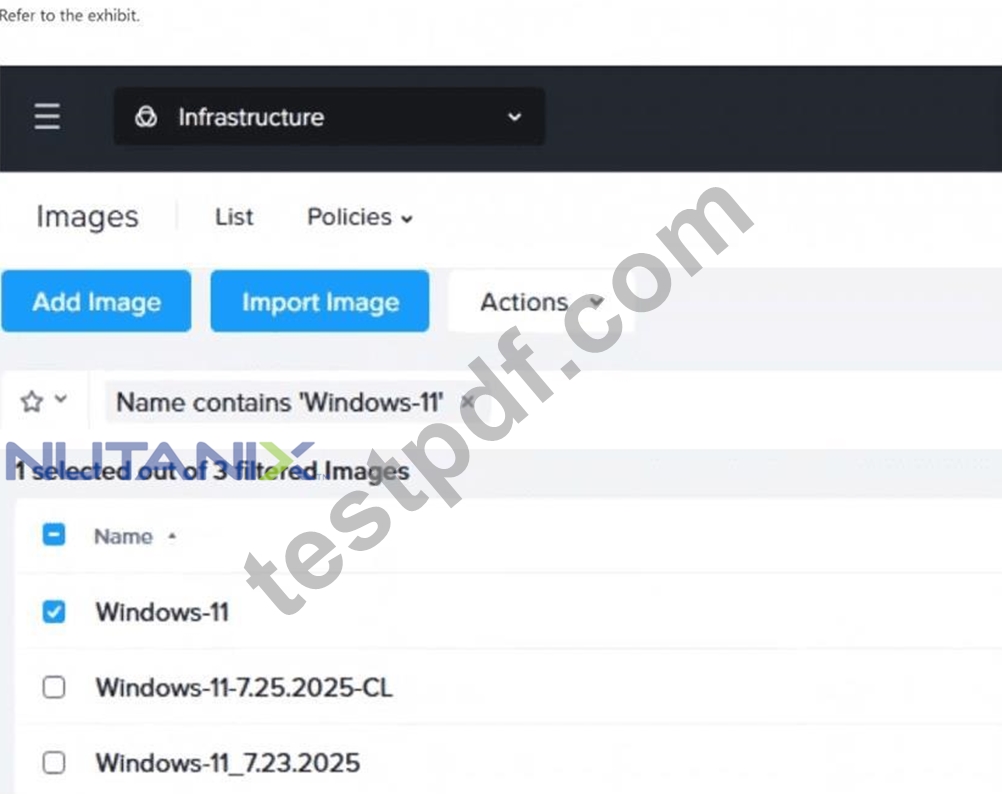
An administrator needs to update an image name to adhere to company image naming standards.
Based upon the exhibit, which option describes the correct solution?
- A. Select the Image -> click Actions -> Update.
- B. Select the Image -> click Actions -> Clone to New Image.
- C. Image names must be updated via the acli command, not the UI.
- D. Image names must be updated via the ncli command, not the UI.
Answer: A
Explanation:
Comprehensive and Detailed Explanation From Exact Extract of Nutanix End User Computing documents:
Based on the provided exhibit and Nutanix Prism Central administration guides:
* Interface Identification: The screenshot displays the Prism Central web console, indicated by the " Infrastructure" dropdown menu in the top navigation bar (Prism Element uses a different layout). The user is currently in the Images dashboard (Infrastructure > Compute > Images).
* Updating Image Metadata: To rename an image (or modify its description/type) in Prism Central, the standard workflow is to select the target image (as shown with "Windows-11" selected) and use the Actions menu.
* The "Update" Action: Within the Actions dropdown menu, the correct option to modify existing settings is Update. Clicking Actions -> Update opens the "Update Image" dialog box, where the Name field is editable.
* Incorrect Options:
* A & D (CLI): These are incorrect because image renaming is fully supported in the UI; the CLI (acli or ncli) is available but not mandatory ("must" is the error).
* C (Clone): Cloning an image creates a duplicate copy. While this could result in a new image with a new name, it is an inefficient workaround rather than the direct solution for simply renaming an existing image.
NEW QUESTION # 37
An administrator is asked to configure storage to support four pools of 250 persistent full clone desktops, and an additional five pools of 200 non-persistent desktops.
What is the optimal configuration for this?
- A. One container with compression only and one with compression and deduplication
- B. Nine containers with Compression Only
- C. Five containers with compression and deduplication and four with compression only
- D. One container with Compression, Deduplication, and Erasure Coding
Answer: A
Explanation:
The optimal storage configuration aligns the container settings with the specific I/O patterns of the workload types:
* Non-Persistent Desktops: These are typically linked clones (MCS/Instant Clones) with high write churn and little data commonality in the delta disks. Compression Only is best. Deduplication adds overhead with no benefit.
* Persistent Full Clones: These are full copies of the OS. Because there are hundreds of copies of the same OS files, Deduplication (Capacity or Performance tier) is highly effective at saving space.
Compression is always recommended.
Therefore, creating two separate containers-one configured with Compression Only (for the non- persistent pools) and one with Compression and Deduplication (for the persistent full clone pools)- provides the best balance of performance and capacity efficiency (Option D).
NEW QUESTION # 38
An administrator needs to add two new nodes to an existing Nutanix cluster. In addition to the default virtual switch vs0, the cluster also has two additional vSwitches defined: vs1 and vs2.
What step does the administrator need to take prior to expanding the cluster?
- A. Ensure the physical NICs in the existing and new nodes are operating at the same speed.
- B. Configure bridge br1 and br2 on the new nodes.
- C. Disable the virtual-switch feature on the cluster.
- D. Ensure AOS and AHV on the new nodes match the cluster versions.
Answer: B
Explanation:
Comprehensive and Detailed Explanation From Exact Extract of Nutanix End User Computing documents:
According to the Nutanix AHV Administration Guide and Cluster Expansion prerequisites for environments with non-default virtual switches:
* Manual Bridge Configuration: When a cluster has multiple virtual switches (e.g., vs1, vs2) configured, these correspond to specific OVS bridges (e.g., br1, br2) on the AHV hosts. Before adding new nodes to such a cluster, the administrator must manually configure these additional bridges on the new nodes to match the existing cluster configuration.
* Consistency Requirement: The documentation states that virtual bridges used for a virtual switch (VS) on all nodes must have the same specification (name, MTU, uplink bond type). If vs1 is mapped to br1 on existing nodes, it must be mapped to br1 on the new nodes before they are added to the cluster.
* Expansion Failure/Warning: Failure to configure these bridges prior to expansion can result in the new nodes being unable to join the configured networks properly or the expansion process failing checks related to network uniformity.
NEW QUESTION # 39
A new large multisite environment is being designed with a requirement to focus on workload availability and failover while reducing the brokering infrastructure footprint and management. Infrastructure components that are deployed must follow vendor recommendations for high availability and redundancy.
Which Citrix control plane should be used and where should they be deployed in this scenario?
- A. Citrix VAD with highly available delivery controllers on AHV workload clusters in each site
- B. Citrix VAD with highly available delivery controllers on AHV infrastructure clusters in each site
- C. Citrix DaaS with highly available cloud connectors on AHV infrastructure clusters in each resource location
- D. Citrix DaaS with highly available cloud connectors on AHV workload clusters in each resource location
Answer: C
Explanation:
Comprehensive and Detailed Explanation From Exact Extract of Nutanix End User Computing documents:
According to Nutanix Validated Designs (NVD) for Citrix DaaS:
* Control Plane: The requirement to "reduce brokering infrastructure footprint" dictates the use of Citrix DaaS (formerly Citrix Cloud), which offloads the Delivery Controllers and SQL databases to the Citrix cloud service, leaving only the lightweight Cloud Connectors on-premises.
* Placement: In a large multisite architecture using the standard "Block and Pod" design, Nutanix recommends separating Management/Infrastructure functions from Workload functions.
* Best Practice: Cloud Connectors are critical infrastructure components. They should be deployed on the AHV Infrastructure Clusters (Management Clusters) in each resource location, rather than the Workload clusters, to ensure they are protected from resource contention caused by user desktops and to maintain a clean separation of duties.
NEW QUESTION # 40
An administrator is using EUC broker software to manage and direct connections to virtual desktops and applications. After losing power to a host in the cluster, the administrator needs to make sure the broker VMs restart. What will happen to the broker VMs in this situation?
- A. The VMs will live migrate to a powered-on host.
- B. The VMs will remain powered off until the host is back online.
- C. Built-in AHV policies will automatically restart the VMs.
- D. A policy must be created so the VMs will power back on.
Answer: C
Explanation:
Nutanix AHV includes a native feature called VM High Availability (VMHA), which protects VMs in the event of a host failure (such as power loss).
When a host fails, the Acropolis High Availability service detects the failure. Built-in AHV policies automatically restart the affected VMs on the remaining healthy hosts in the cluster.
Live migration (Option D) is not possible because the host is already down (powered off), meaning the memory state cannot be transferred; the VMs must be restarted (booted) on new hosts. No manual policy creation (Option B) is required as this is a core default function of the AHV cluster, provided resources are available.
NEW QUESTION # 41
An administrator has created a Prism Central Playbook Action named Virtual Desktop Add CPU to add 2 vCPU to virtual desktop when an alert is triggered after the virtual desktop's CPU usage has exceeded 80%.
Initially the Playbook Action works as expected, however over time it seems it is no longer being triggered.
What is causing this issue?
- A. The vNUMA boundary has been breached preventing more vCPUs to be added.
- B. The virtual desktop CPU Usage alerts were not cleared.
- C. Additional vCPUs need to be registered.
- D. There are no more CPUs availed to allocate to the VM.
Answer: B
Explanation:
https://next.nutanix.com/community-blog-154/new-x-play-actions-in-prism-central-2021-7-40005 The Prism Central Playbook Action is a tool that allows you to automate tasks based on triggers, such as events, alerts, or webhooks. You can define a series of actions (called a playbook) that perform operations on your infrastructure, such as adding or reducing resources on a VM2.
To use the Playbook Action for VMs, you need to meet some prerequisites, such as:
The Prism Central version must be 2020.11 or later.
The AOS version must be 5.15 LTSR or later.
The hypervisor must be AHV or ESXi.
The VMs must have Nutanix Guest Tools (NGT) installed and enabled3.
One of the possible reasons why the Playbook Action is no longer being triggered is that the virtual desktop CPU Usage alerts were not cleared. According to the Prism Central guide3, "If an alert has been triggered once and has not been cleared yet, then it will not trigger any action again until it has been cleared". Therefore, if the CPU Usage alert remains active for a virtual desktop, it will prevent the Playbook Action from adding more vCPUs to it.
NEW QUESTION # 42
What should the administrator use when creating a Windows 10 gold image using Calm for Citrix MCS persistent desktops?
- A. VMware optimized Windows 10 image.
- B. Microsoft downloaded Windows 10 ISO image.
- C. Snapshot of Citrix optimized Windows 10 image.
- D. Sysprepped Microsoft Windows 10 image
Answer: C
Explanation:
A snapshot is a point-in-time copy of a virtual machine that can be used as a template for creating new machines. A Citrix optimized Windows 10 image is a Windows 10 image that has been configured with best practices and optimizations for Citrix Virtual Apps and Desktops.
Using a snapshot of a Citrix optimized Windows 10 image can ensure that the persistent desktops have consistent performance, security, and user experience. It can also simplify the image management process by allowing you to update the snapshot with new patches or applications using Calm.
Calm is a tool that automates application lifecycle management across different environments. Calm can integrate with Citrix MCS to create, update, and delete virtual machines based on blueprints that define the configuration and dependencies of an application.
https://www.nutanix.com/support-services/training-certification/certifications/certification-details-nutanix-certified-professional-ncp-euc-v6
NEW QUESTION # 43
A company is planning to implement Citrix Virtual Apps and Desktops on Nutanix clusters running AHV.
The initial implementation will be sized for 1000 virtual desktops with Windows 1 1, Microsoft Office 2021 and Adobe Creative Cloud All Apps installed.
What is the correct prerequisite to implement a successful installation of the Nutanix AHV MCS Plug-in?
- A. Nutanix cluster virtual IP address is reachable.
- B. The user running Nutanix AHV MCS installer must have administrator privileges on the Citrix Storefront.
- C. The user running Nutanix AHV MCS installer must have administrator privileges on the Citrix Broker.
- D. Nutanix data services IP address is reachable.
Answer: C
Explanation:
The Nutanix AHV MCS Plug-in is a tool that enables Citrix Virtual Apps and Desktops Delivery Controllers (also called Brokers) to create and manage Citrix-provisioned VMs in a Nutanix AHV infrastructure environment. The plug-in is based on the Citrix-defined plug-in framework2.
To install the Nutanix AHV MCS Plug-in, you need to meet some prerequisites, such as:
* The Delivery Controller version must be 7.15 LTSR CU3 or later.
* The Delivery Controller must be able to communicate with Prism Element (PE) using HTTPS port
9440.
* The Delivery Controller must have PowerShell 5.1 or later installed.
* The user running the installer must have administrator privileges on the Delivery Controller2.
https://portal.nutanix.com/page/documents/solutions/details?targetId=RA-2020-Citrix-Virtual-Apps-and- Desktops-AMD-MCS-Windows-10:RA-2020-Citrix-Virtual-Apps-and-Desktops-AMD-MCS-Windows-10
NEW QUESTION # 44
An administrator needs to migrate a VM with a GPU to a new platform. The VM will be migrating from ESXi to Nutanix.
What configuration is permissible?
- A. All GPU nodes must run the same version of the driver
- B. On a subset of GPU-enabled nodes
- C. Different versions of the driver on different nodes in the cluster
- D. On a single GPU-enabled node
Answer: A
Explanation:
For Virtual Machine operations involving vGPUs (NVIDIA GRID) on Nutanix AHV, it is a strict requirement that all GPU nodes must run the same version of the host driver.
To support VM mobility, live migration, and High Availability (HA) within the cluster, the source and destination hosts must have compatible GPU profiles and identical driver versions. If drivers are mismatched between nodes, the GPU state cannot be successfully transferred or re-initialized, preventing migration and potentially causing VM power-on failures. While a cluster can contain a subset of nodes with GPUs (heterogeneous cluster), the nodes that do have GPUs must be uniform in their driver configuration.
NEW QUESTION # 45
......
Download Latest & Valid Questions For Nutanix NCP-EUC exam: https://pass4sure.testpdf.com/NCP-EUC-practice-test.html
