

TestPDF C_BCBAI_2502 dumps & SAP Certified Associate Sure Practice with 70 Questions
New C_BCBAI_2502 Exam Questions| Real C_BCBAI_2502 Dumps
SAP C_BCBAI_2502 Exam Syllabus Topics:
| Topic | Details |
|---|---|
| Topic 1 |
|
| Topic 2 |
|
| Topic 3 |
|
NEW QUESTION # 17
(Which of the following is Effective AI built on? Note: There are 2 correct answers to this question.)
- A. Open source LLMs
- B. Robust data foundation
- C. Seamless integration
- D. Cutting-edge algorithms or real-time processing
Answer: B,C
Explanation:
Comprehensive and Detailed Explanation From Exact Extract: Effective AI in the context of SAP Business AI is built on a robust data foundation to ensure accurate and contextually relevant outcomes, and seamless integration to embed AI capabilities directly into business processes and applications for efficient deployment and scalability. This foundation enables customized AI solutions that leverage enterprise data securely while integrating with SAP and non-SAP systems.
Exact extracts supporting this:
"Effective AI is built on a robust data foundation and seamless integration, particularly when it involves customized AI solutions on the SAP ..."learning.sap.com From SAP Business AI principles: AI is "grounded in business data and embedded into every business function," emphasizing the data foundation and integration for effectiveness.sap.com
"Maximize the value of AI across your business with a single AI interface that seamlessly integrates data and workflows across your SAP and non-SAP applications."sap.com Other options are incorrect because:
Option A: While algorithms and processing are important, SAP emphasizes data and integration over cutting-edge algorithms alone for effective AI in business contexts.
Option C: SAP supports a range of LLMs, including proprietary ones, but does not position effective AI specifically on open-source models; focus is on secure, business-grounded AI.
Reference from Positioning SAP Business AI Solutions as part of SAP Business Suite documents or Study Guide: Derived from the SAP Learning Journey "Boosting Your Cloud Transformation Journey with SAP Business AI and Generative AI," specifically the unit "Building Custom SAP Business AI Solutions," which highlights effective AI's reliance on data foundations and integration. Supported by the SAP Business AI product page, aligning with C_BCBAI_2502 certification materials for positioning AI solutions.
NEW QUESTION # 18
Which SAP Business AI solutions assist in intelligent document processing? Note: There are 2 correct answers to this question.
- A. SAP Conversational AI
- B. SAP AI Business Services
- C. SAP SuccessFactors AI
- D. SAP Intelligent Robotic Process Automation (RPA)
Answer: B,D
Explanation:
SAP Business AI provides solutions to automate and streamline intelligent document processing, particularly for handling unstructured data in financial and operational workflows. The correct answers are SAP AI Business Services and SAP Intelligent Robotic Process Automation (RPA), as these solutions are specifically designed to process documents intelligently using AI capabilities.
SAP documentation states: "SAP AI Business Services include capabilities like document information extraction, which leverages machine learning to process unstructured documents such as invoices and payment advice, integrating them seamlessly into business processes." For example, SAP Cash Application uses SAP AI Business Services to "intelligently extract key payment details from unstructured PDF documents" for financial reconciliation. Similarly, SAP Intelligent RPA is highlighted for its ability to
"automate repetitive tasks such as data entry and document processing" by combining robotic process automation with AI to handle complex documents efficiently. This is particularly useful in scenarios like invoice processing, where RPA bots extract and validate data from documents.
The incorrect options-SAP SuccessFactors AI and SAP Conversational AI-are not relevant to document processing. SAP SuccessFactors AI focuses on HR processes like recruitment and workforce analytics, while SAP Conversational AI is designed for natural language interactions, such as chatbots, not document handling. SAP's emphasis on automation in finance and procurement, as seen in solutions like SAP S
/4HANA, underscores the suitability of SAP AI Business Services and SAP Intelligent RPA for intelligent document processing.
NEW QUESTION # 19
Which SAP solution provides a centralized platform for tracking sustainability performance?
Please choose the correct answer.
Response:
- A. SAP Fieldglass
- B. SAP Sustainability Control Tower
- C. SAP Extended Warehouse Management
- D. SAP Business One
Answer: B
NEW QUESTION # 20
(What is Deep Learning?)
- A. AI systems that use self-supervised learning on vast data to perform a variety of tasks, such as writing documents or creating images.
- B. A branch of Machine Learning that uses multi-layered neural networks to analyze complex data patterns that may employ different learning methods.
- C. A technology that equips machines with human-like capabilities such as problem-solving, visual perception, speech recognition, decision-making, and language translation.
- D. A subset of AI that focuses on enabling computer systems to learn and improve from experience or data, incorporating elements from fields like computer science, statistics, and psychology.
Answer: B
Explanation:
Comprehensive and Detailed Explanation From Exact Extract: Deep Learning is a branch of Machine Learning that utilizes multi-layered neural networks to analyze and interpret complex data patterns, often employing various learning methods such as supervised, unsupervised, or reinforcement learning. This distinguishes it from broader AI definitions, general machine learning, or specific foundation model applications.
Exact extracts supporting this:
"Deep learning is the specialized subtype of machine learning that processes and interprets the complex inputs, including visual data from ..."sap.com
"Deep learning (DL) is a data-centric subset of machine learning that uses neural networks with multiple (deep) layers to learn and extract features from ..."sap.com
"Unlike machine learning algorithms that rely heavily on structured data inputs, deep learning models can effectively process unstructured data ..."community.sap.com Other options are incorrect because:
Option A: This describes artificial intelligence (AI) in general, which encompasses human-like capabilities across various domains.
Option B: This defines machine learning (ML), the broader field focused on learning from data without explicit programming.
Option D: This refers to foundation models or generative AI systems that use self-supervised learning for multi-modal tasks.
Reference from Positioning SAP Business AI Solutions as part of SAP Business Suite documents or Study Guide: Sourced from the official SAP resource "What is deep learning? | SAP" and SAP Learning course "Summarizing AI," which position deep learning as a subset of machine learning within SAP Business AI frameworks. Additional support from SAP Community blogs on understanding AI, ML, and DL, aligned with C_BCBAI_2502 certification materials for explaining AI concepts in business contexts.
NEW QUESTION # 21
Which SAP module focuses on workplace safety and environmental compliance? Please choose the correct answer.
- A. SAP Business Network
- B. SAP Predictive Analytics
- C. SAP Financial Closing Cockpit
- D. SAP Environment, Health, and Safety (EHS)
Answer: D
Explanation:
SAP Environment, Health, and Safety (EHS) is the dedicated module for managing workplace safety and environmental compliance, ensuring organizations meet regulatory and sustainability standards. The correct answer is SAP Environment, Health, and Safety (EHS), as it is explicitly designed for this purpose.
SAP documentation states: "SAP Environment, Health, and Safety (SAP EHS) supports companies in managing workplace safety, environmental compliance, and sustainability initiatives. It helps organizations comply with global regulations, ensure safe working conditions, and track environmental performance." SAP EHS enables companies to "monitor workplace incidents, manage safety protocols, and report on environmental compliance," such as emissions and waste management, to meet regulatory requirements. For example, it supports "tracking and reporting environmental data" to ensure adherence to standards, aligning with SAP's sustainability-focused solutions.
The incorrect options are unrelated to workplace safety and environmental compliance. SAP Business Network focuses on supplier collaboration and procurement, not safety or compliance. SAP Financial Closing Cockpit is used for financial reporting, not environmental or safety management. SAP Predictive Analytics supports forecasting and trend analysis, not compliance. SAP EHS is the clear choice for this purpose, as confirmed by its role in SAP's sustainability portfolio.
NEW QUESTION # 22
How does SAP AI support HR operations? Note: There are 2 correct answers to this question.
- A. Manual job application sorting
- B. Predictive workforce analytics
- C. AI-powered recruitment and candidate screening
- D. Legacy payroll processing without AI integration
Answer: B,C
Explanation:
SAP AI enhances HR operations by automating processes and providing data-driven insights to optimize recruitment and workforce management. The correct answers are AI-powered recruitment and candidate screening and predictive workforce analytics, as these are core functionalities documented in SAP's HR AI solutions.
SAP documentation states: "AI in human resources involves using artificial intelligence to streamline and enhance HR processes such as recruitment, employee engagement, and performance management. It automates repetitive tasks, analyzes large volumes of data for better decision-making, and offers personalized experiences for employees." SAP SuccessFactors AI supports AI-powered recruitment and candidate screening by "using machine learning to analyze candidate profiles and match them to job requirements," improving hiring efficiency. Predictive workforce analytics enables organizations to "predict employee attrition rates and workforce trends" by analyzing data on engagement, performance, and skills, as seen in SAP SuccessFactors' talent intelligence hub. For example, FC Bayern's use of SAP SuccessFactors AI demonstrates enhanced recruitment and retention through predictive insights.
The incorrect options-manual job application sorting and legacy payroll processing without AI integration- are not AI-driven. Manual job application sorting contradicts SAP's automation focus, and legacy payroll processing without AI is outdated and not part of SAP's modern HR solutions. SAP's emphasis on AI-driven HR processes confirms the selected functionalities.
NEW QUESTION # 23
Which SAP AI-powered tool enhances financial forecasting accuracy?
Please choose the correct answer.
Response:
- A. SAP Intelligent Robotic Process Automation
- B. SAP SuccessFactors
- C. SAP AI Business Services
- D. SAP Predictive Analytics
Answer: D
NEW QUESTION # 24
A manufacturing firm wants to use AI to predict machine failures and optimize maintenance schedules. Which SAP solutions should they implement?
There are 3 correct answers to this question.
Response:
SAP Predictive Maintenance
- A. SAP Conversational AI
- B. SAP Blockchain for Business
- C. SAP Digital Manufacturing Cloud
- D. SAP AI Business Services
Answer: A,C,D
NEW QUESTION # 25
(What is Machine Learning?)
- A. AI systems that use self-supervised learning on vast data to perform a variety of tasks, such as writing documents or creating images.
- B. A technology that equips machines with human-like capabilities such as problem-solving, visual perception, speech recognition, decision-making, and language translation.
- C. A subset of AI that focuses on enabling computer systems to learn and improve from experience or data, incorporating elements from fields like computer science, statistics, and psychology.
- D. A form of deep learning that utilizes foundation models, like large language models, to create new content, including text, images, sound, and videos, based on the data it was trained on.
Answer: C
Explanation:
Comprehensive and Detailed Explanation From Exact Extract: Machine Learning is defined as a subset of AI that enables computer systems to learn and improve from experience or data, incorporating elements from fields like computer science, statistics, and psychology. This distinguishes it from general AI, generative AI, or foundation models, focusing on data-driven learning without explicit programming.
Exact extracts supporting this:
"Machine learning is a subset of artificial intelligence (AI) in which computers learn from data and improve with experience without being explicitly programmed."sap.com
"Machine learning (ML) is a subset of AI that enables computer systems to learn and improve from experience or data, and incorporates elements from fields like computer science, statistics, and psychology."sap.com
"Machine learning is a subset of artificial intelligence (AI). It is focused on teaching computers to learn from data and to improve with experience - instead of ..."learning.sap.com Other options are incorrect because:
Option A: This describes foundation models or generative AI systems that use self-supervised learning for multi-task performance, not specifically machine learning.
Option C: This refers to generative AI, a specific application of deep learning using foundation models for content creation.
Option D: This defines artificial intelligence in general, encompassing human-like capabilities beyond just learning from data.
Reference from Positioning SAP Business AI Solutions as part of SAP Business Suite documents or Study Guide: Drawn from the SAP product page "What is Machine Learning?" and the SAP Learning course "Discovering SAP Business AI," which positions machine learning as a foundational subset of AI within SAP Business AI solutions integrated into the SAP Business Suite. Supported by SAP Help Portal glossaries and community blogs, as aligned with C_BCBAI_2502 certification for explaining AI concepts.
NEW QUESTION # 26
Which SAP AI tool provides businesses with chatbots for automated customer interactions?
Please choose the correct answer.
Response:
- A. SAP Business AI Core
- B. SAP Conversational AI
- C. SAP Cloud ERP AI
- D. SAP Intelligent RPA
Answer: B
NEW QUESTION # 27
A logistics company is looking to reduce delivery delays and improve inventory management. Which SAP AI-powered solutions should they implement?
There are 3 correct answers to this question.
Response:
- A. SAP AI Business Service
- B. SAP BusinessObjects Planning
- C. SAP Cloud ERP
- D. SAP Predictive Analytics
- E. SAP Digital Manufacturing Cloud
Answer: A,D,E
NEW QUESTION # 28
What are the key Business Al patterns?
There are 3 correct answers to this question.
Response:
- A. Insight Apps, Data for AI
- B. Al Lifecycle Management
- C. Custom Generative Al Extensions
- D. Enterprise Automation
- E. Digital Assistants with SAP
Answer: A,D,E
NEW QUESTION # 29
What are the benefits of SAP AI-driven predictive analytics? Note: There are 3 correct answers to this question.
- A. Automated anomaly detection
- B. Future trend forecasting
- C. Real-time decision-making insights
- D. Increased manual data entry
- E. Manual invoice processing
Answer: A,B,C
Explanation:
SAP AI-driven predictive analytics provides significant benefits by enabling organizations to anticipate trends, make informed decisions, and automate anomaly detection. The correct answers are future trend forecasting, real-time decision-making insights, and automated anomaly detection, as these are core benefits documented in SAP's AI portfolio.
SAP documentation states: "SAP Business AI offers predictive analytics to enhance decision-making, provide personalized insights, and improve business processes. It supports future trend forecasting, real-time decision- making, and automated anomaly detection across functions like finance, supply chain, and marketing." Future trend forecasting allows organizations to "predict customer demand, financial trends, and operational risks," as seen in SAP S/4HANA's forecasting of incoming payments. Real-time decision-making insights enable
"proactive responses to market changes" by analyzing live data, such as in SAP Integrated Business Planning.
Automated anomaly detection identifies "unusual patterns in financial transactions or supply chain operations," enhancing security and efficiency, as exemplified by SAP AI Business Services' fraud detection capabilities.
The incorrect options-increased manual data entry and manual invoice processing-are contrary to SAP's automation focus. Predictive analytics aims to reduce manual efforts, not increase them, and manual invoice processing is replaced by solutions like SAP Cash Application. SAP's emphasis on AI-driven automation and insights, as seen in case studies like Henkel's supply chain optimization, confirms the selected benefits.
NEW QUESTION # 30
A multinational company wants to implement AI-based fraud detection for its financial transactions. Which SAP AI solutions should they use? Note: There are 3 correct answers to this question.
- A. SAP Cloud ERP
- B. SAP Predictive Analytics
- C. SAP Intelligent RPA
- D. SAP AI Business Services
- E. SAP SuccessFactors AI
Answer: B,C,D
Explanation:
For a multinational company seeking AI-based fraud detection in financial transactions, SAP offers solutions that leverage machine learning and automation to identify and mitigate fraudulent activities. The correct answers are SAP AI Business Services, SAP Predictive Analytics, and SAP Intelligent RPA, as these solutions directly support fraud detection in financial processes.
SAP documentation explains: "SAP AI solutions can detect anomalies and patterns in financial transactions, procurement processes, and other business operations to identify potential fraud and risks." SAP AI Business Services provide "machine learning capabilities for fraud detection in finance," enabling real-time monitoring of transactions to identify suspicious activities. SAP Predictive Analytics, embedded in SAP S/4HANA, supports "AI-assisted anomaly detection" to "predict and identify unusual patterns in financial data," such as fraudulent transactions, enhancing security. SAP Intelligent RPA automates "transaction monitoring and validation processes," using AI to flag potential fraud by cross-referencing data against predefined rules, as seen in financial reconciliation workflows.
The incorrect options-SAP SuccessFactors AI and SAP Cloud ERP-are not relevant. SAP SuccessFactors AI focuses on HR processes, such as recruitment, not financial fraud detection. SAP Cloud ERP is a broad platform that may include AI but is not specifically tailored for fraud detection compared to the selected solutions. SAP's financial AI solutions, as evidenced by their use in SAP Cash Application, confirm the suitability of the chosen answers.
NEW QUESTION # 31
(What are some functions that the SAP Build Code with code generation add-on provides? Note: There are 2 correct answers to this question.)
- A. Insert code snippets through Joule
- B. Generate unit tests for ABAP classes
- C. Explain existing code
- D. Refactor CAP projects
Answer: B,C
Explanation:
Comprehensive and Detailed Explanation From Exact Extract: The SAP Build Code with code generation add-on, powered by Joule, provides functions such as explaining existing code through code reviews and comments, and generating unit tests for ABAP classes by selecting methods and using AI-based features to create tests efficiently.
Exact extracts supporting this:
Explain existing code: "/cap-edit-model: Edits existing CAP data models, supports code reviews, adds comments, and answers questions like 'Does this code follow the best practices of CAP?'"community.sap.com "/ui5: Explains UI5-related artifacts, e.g., 'What does the code in the main controller do?', with options to consider selected code without specifying files."community.sap.com "Code Commenting via Joule Code Assistant, generating explanatory comments for selected code, with accept/reject options."community.sap.com Generate unit tests for ABAP classes: "With Joule for developers, ABAP AI capabilities, you can easily access AI-based features designed to help you create ABAP Unit tests."help.sap.com "Navigate to any of the specified views and select a public method from a global ABAP class. Open the context menu and select Joule Generate Unit Tests."help.sap.com Other options are incorrect because:
Option B: While Joule supports inline code-completion for suggesting snippets, this is a general feature rather than a specific function of the code generation add-on, which focuses on broader generation tasks like models and tests rather than snippet insertion.
Option C: Refactoring is supported for CAP projects through editing models and code refactor assistants, but it is not highlighted as a primary function of the code generation add-on, which emphasizes generation and explanation over refactoring.
Reference from Positioning SAP Business AI Solutions as part of SAP Business Suite documents or Study Guide: Based on SAP Community blogs like "Overview of all GenAI Options in SAP Build Code" and "Develop with Joule in SAP Build Code," as well as SAP Help Portal documentation on ABAP AI capabilities in SAP Build Code. These align with the C_BCBAI_2502 certification, positioning SAP Build Code as an AI-enhanced development tool within the SAP Business Suite for Java, JavaScript, and ABAP.
NEW QUESTION # 32
What are the key Business AI patterns? Note: There are 3 correct answers to this question.
- A. Insight Apps, Data for AI
- B. Custom Generative AI Extensions
- C. AI Lifecycle Management
- D. Enterprise Automation
- E. Digital Assistants with SAP
Answer: A,D,E
Explanation:
SAP Business AI is structured around key patterns that define how AI is applied across business processes.
The correct answers are Digital Assistants with SAP, Enterprise Automation, and Insight Apps, Data for AI, as these are explicitly documented as core Business AI patterns in SAP's framework.
SAP documentation states: "SAP Business AI is built around key patterns that enable organizations to leverage AI effectively: Digital Assistants with SAP, Enterprise Automation, and Insight Apps, Data for AI." Digital Assistants with SAP, exemplified by Joule, provide "natural language interfaces to interact with business processes," enhancing user productivity. Enterprise Automation involves "using AI-driven automation, such as SAP Intelligent RPA, to streamline repetitive tasks and optimize workflows" across functions like finance and supply chain. Insight Apps, Data for AI refers to "delivering predictive analytics and data-driven insights" through applications like SAP S/4HANA, which support decision-making with real- time data.
The incorrect options-AI Lifecycle Management and Custom Generative AI Extensions-are not listed as primary Business AI patterns. AI Lifecycle Management is a technical process for managing AI models, not a business pattern. Custom Generative AI Extensions, while emerging, are not a core pattern in SAP's current Business AI framework, which focuses on established use cases. SAP's emphasis on these patterns, as seen in its AI strategy, confirms the selected answers.
NEW QUESTION # 33
A manufacturing firm wants to use AI to predict machine failures and optimize maintenance schedules.
Which SAP solutions should they implement? Note: There are 3 correct answers to this question.
- A. SAP Predictive Analytics
- B. SAP Blockchain for Business
- C. SAP Digital Manufacturing Cloud
- D. SAP AI Business Services
Answer: A,C,D
Explanation:
For a manufacturing firm aiming to predict machine failures and optimize maintenance schedules, SAP offers AI-driven solutions that enhance predictive maintenance and operational efficiency. The correct answers are SAP Digital Manufacturing Cloud, SAP AI Business Services, and SAP Predictive Analytics, as these solutions directly support AI-driven predictive maintenance in manufacturing.
SAP documentation highlights: "SAP Digital Manufacturing Cloud leverages AI to optimize production processes, including predictive maintenance to prevent machine failures and improve operational efficiency." This solution uses real-time data and machine learning to "predict equipment failures and schedule maintenance proactively," reducing downtime and costs. SAP AI Business Services provide reusable AI capabilities, such as predictive analytics and anomaly detection, to "support predictive maintenance by analyzing equipment data and identifying potential issues before they occur." These services integrate with SAP S/4HANA to monitor machine performance and trigger maintenance workflows. SAP Predictive Analytics, embedded in solutions like SAP S/4HANA, enables "predicting equipment failures by analyzing historical and real-time data," allowing manufacturers to optimize maintenance schedules based on predictive insights.
The incorrect option-SAP Blockchain for Business-is not relevant, as it focuses on securetransactions, not predictive maintenance. SAP's case studies, such as those involving SAP Digital Manufacturing Cloud, demonstrate its effectiveness in optimizing manufacturing processes through AI-driven maintenance. The inclusion of SAP Predictive Analytics as a third answer aligns with its documented role in manufacturing, as seen in SAP's predictive maintenance use cases, ensuring three correct answers as required.
NEW QUESTION # 34
Which key advantage does SAP Business AI provide to organizations?
Please choose the correct answer.
Response:
- A. Predictive insights for decision-making
- B. Manual business process execution
- C. Automated financial accounting processes
- D. Isolated data storage without AI integration
Answer: A
NEW QUESTION # 35
(What are some advantages of SAP's generative AI hub? Note: There are 3 correct answers to this question.)
- A. Fine-tune generic LLMs
- B. Orchestrate multiple LLMs
- C. Ensure secure and trusted operations
- D. Use SAP anonymized data
- E. Rely on data privacy policies
Answer: A,B,C
Explanation:
Comprehensive and Detailed Explanation From Exact Extract: The advantages of SAP's generative AI hub include the ability to orchestrate multiple large language models (LLMs) for complex scenarios, fine-tune generic LLMs to customize solutions, and ensure secure and trusted operations through enterprise-grade security and compliance. These features enable developers to build reliable AI applications while maintaining data privacy and operational efficiency.
Exact extracts supporting this:
Orchestrate multiple LLMs: "Generative AI hub is a central cockpit that allows developers to create, operate, monitor, and orchestrate their generative AI scenarios."learning.sap.com "The generative AI hub in SAP AI Core infrastructure provides customers with secure access to a broad range of large language models (LLMs)."news.sap.com Fine-tune generic LLMs: "Improvements to the generative AI hub capability in SAP AI Core and SAP AI Launchpad will allow developers to build, customize, and deploy complex AI-driven solutions more efficiently."sap.com "Choose from a selection of generative AI models for prompt experimentation and prompt lifecycle management."help.sap.com Ensure secure and trusted operations: "It also ensures secure and trusted operations with enterprise-grade security and compliance."help.sap.com "The generative AI hub provides customers with secure access to a broad range of large language models (LLMs) that ..."news.sap.com "Enables developers to build, customize, and deploy complex AI-driven solutions more efficiently and with greater confidence."sap.com Other options are incorrect because:
Option B: While data privacy is upheld, the advantage is more about ensuring secure operations rather than merely relying on policies; the hub actively enforces privacy through its design.
Option D: The hub focuses on using customer data securely for customization, not specifically on SAP anonymized data as a primary advantage.
Reference from Positioning SAP Business AI Solutions as part of SAP Business Suite documents or Study Guide: Sourced from the SAP product page "Generative AI | SAP Artificial Intelligence Innovations" and SAP Help Portal for SAP AI Core, as well as community blogs on the generative AI hub. These resources position the hub within SAP BTP for building custom AI solutions in the SAP Business Suite, emphasized in the C_BCBAI_2502 certification and learning journeys like "Boosting Your Cloud Transformation Journey with SAP Business AI and Generative AI."
NEW QUESTION # 36
Drag and drop the key terms to the correct position.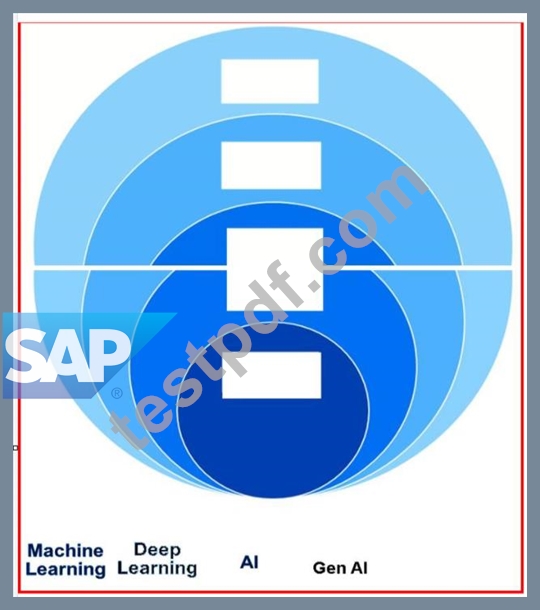
Answer:
Explanation: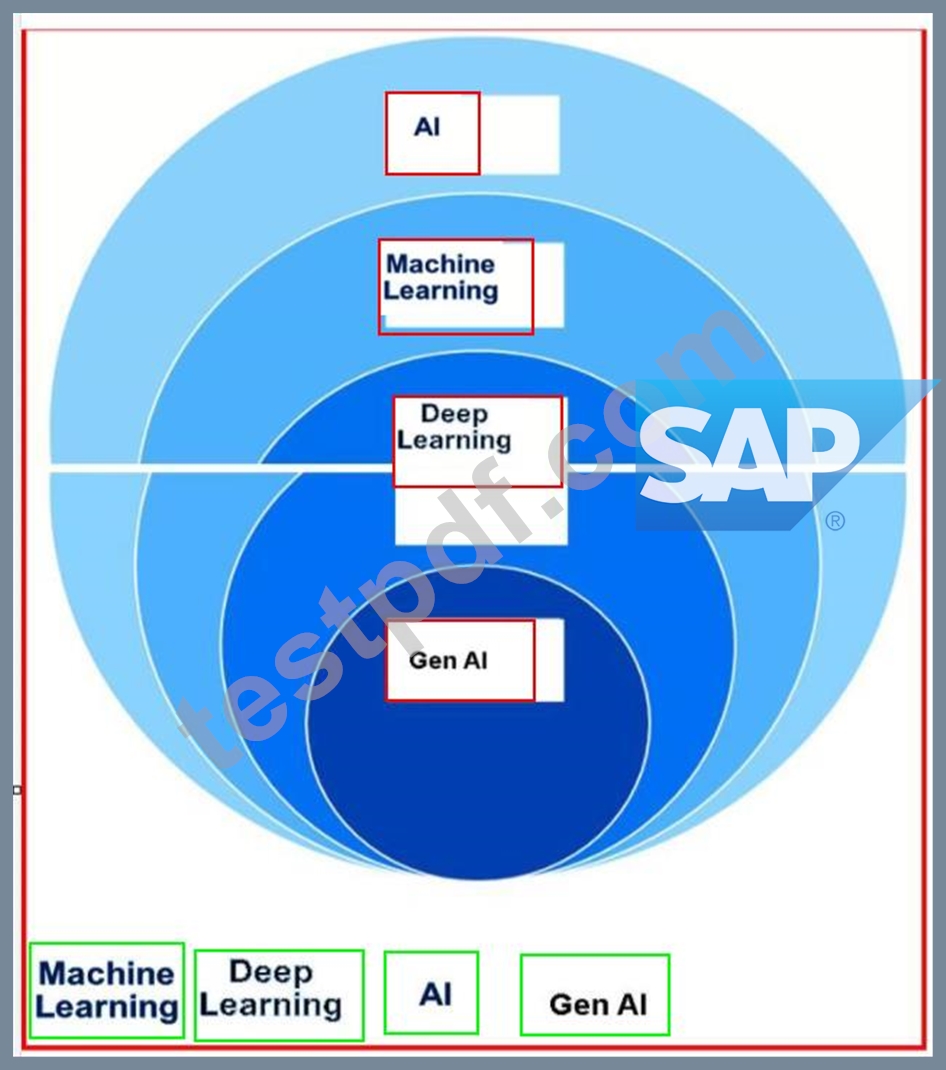
NEW QUESTION # 37
Which AI-driven tools are available in SAP S/4HANA?
There are 2 correct answers to this question.
Response:
- A. Isolated financial processes without AI
- B. AI-powered invoice processing
- C. Predictive analytics for financial forecasting
- D. Manual risk assessment
Answer: B,C
NEW QUESTION # 38
Drag and drop the elements at the bottom to the architecture layers of the SAP LeanlX meta model.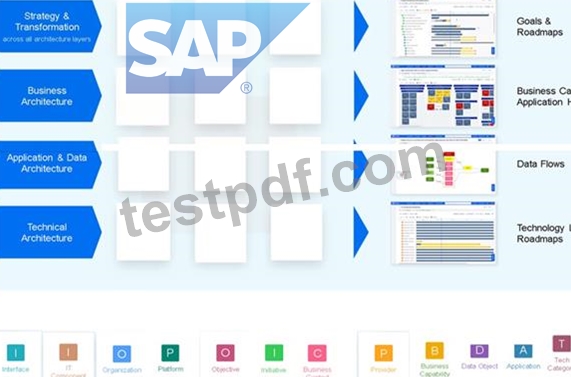
Answer:
Explanation: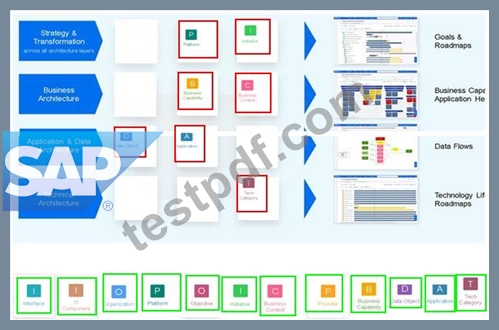
NEW QUESTION # 39
......
C_BCBAI_2502 Braindumps – C_BCBAI_2502 Questions to Get Better Grades: https://pass4sure.testpdf.com/C_BCBAI_2502-practice-test.html
