

Enhance Your Career With Available Preparation Guide for CIS-DF Exam
Get Special Discount Offer of CIS-DF Certification Exam Sample Questions and Answers
NEW QUESTION # 46
A CMDB Administrator has installed aService Graph Connectorand customized ascript transform.
What will happen on subsequent upgrades if thedefault definition of the script transform is updated?
- A. A skipped change is created and no change is made to the script transform definition
- B. The Service Graph Connector upgrade refuses to start
- C. The upgrade stops and reports an error
Answer: A
Explanation:
InServiceNow, Service Graph Connectors deliver data ingestion patterns usingprotected, upgrade-safe artifacts, including script transforms. When a customercustomizesa script transform provided by a Service Graph Connector, ServiceNow follows standardupdate set and upgrade behaviorto protect customer customizations.
During a subsequent upgrade, if theout-of-box (default) script transform definition changes, ServiceNowdoes not overwrite the customized version. Instead, the platform records askipped change, indicating that an update was available but intentionally not applied due to a local customization. This ensures customer-specific logic is preserved while still maintaining transparency about what changed in the newer release.
Option A is incorrect because upgrades do not halt due to customized transforms. Option C is also incorrect because Service Graph Connector upgrades proceed normally; they do not refuse to start because of customizations.
This behavior aligns with Data Foundations best practices:avoid modifying OOTB content when possible, but when customization is necessary, ensure it is protected during upgrades. Administrators should review skipped changes after upgrades to decide whether to manually adopt new OOTB logic.
Therefore, the correct answer isB - A skipped change is created and no change is made to the script transform definition.
NEW QUESTION # 47
A Configuration Management Process Owner is preparing solution options for presentation to the technical governance board for ingesting custom CIs to the CMDB. The solution needs to align with best practice, minimize the cost of future work (technical debt), and ensure compliance with future upgrades.
Which solutions accomplish this? (Choose two.)
- A. Repurposing a base CI class and renaming attributes, as required
- B. Extending an existing CI class table to accommodate the custom CI class attributes
- C. Extending an existing Asset class table to accommodate the custom CI class attributes
- D. Installing or upgrading the CMDB CI Class Models store application to find a suitable existing CI class accommodating any new attributes
Answer: B,D
Explanation:
Data Foundations emphasizes that "ingest" must produce CMDB data that is standardized, supportable, and upgrade-safe. When introducing custom CIs, the best practice is to reuse the most appropriate existing CI class (or an approved industry-aligned model) and only add what is necessary--this keeps the data model aligned with platform expectations and reduces downstream rework.
Option B supports this directly: the CMDB CI Class Models application is intended to help teams select a suitable existing class rather than inventing new classes unnecessarily. Reusing existing classes improves consistency across integrations, Discovery/Service Mapping patterns, reporting, and CMDB Health rules--reducing technical debt and making future platform upgrades smoother.
Option A is also aligned with best practice when used correctly: once you have the right CI class, extending that class to add additional attributes (new fields) is a standard, upgrade-safe customization approach. It preserves the underlying platform data structures and avoids breaking out-of-box behaviors, identification/reconciliation practices, and CMDB Health evaluations.
NEW QUESTION # 48
Drag and Drop Question
Given a list of Service types in the platform, drag the appropriate service to its definition.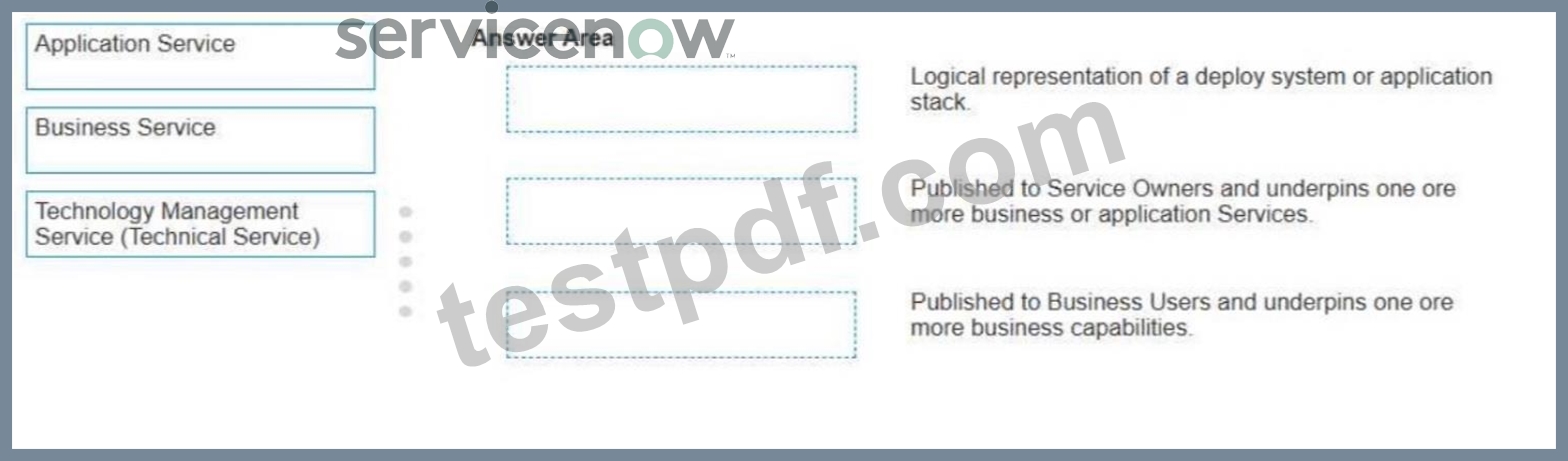
Answer:
Explanation:
Explanation:
Within the Common Service Data Model (CSDM), service types are clearly defined to separate business-facing value, application logic, and technical enablement. Correct classification is foundational to impact analysis, ownership, reporting, and service visibility.
An Application Service is a logical representation of a deployed application or system stack. It models how an application runs, including servers, databases, middleware, and integrations.
Application Services are typically created and maintained through Service Mapping and are primarily consumed by IT operations, DevOps, and support teams.
A Technology Management Service (also called a Technical Service) represents shared technical capabilities such as databases, authentication platforms, messaging systems, or cloud infrastructure. These services are published to Service Owners, not business users, and underpin one or more Application Services or Business Services. They are critical for understanding technical dependencies and risk but are not business-facing.
A Business Service is published to Business Users and directly supports business capabilities and outcomes. It represents what the business consumes, such as "Online Banking," "Order Fulfillment," or "Employee Onboarding." Business Services sit at the top of the CSDM hierarchy and are the anchor point for SLAs, experience, and value measurement.
Correctly distinguishing these service types ensures alignment with CSDM best practices, enables accurate impact analysis, and prevents common CMDB anti-patterns such as exposing technical services to business users or misrepresenting application stacks as business value.
NEW QUESTION # 49
In a company, there is a need to understand the CSDM maturity level required. Different stakeholders listed several use cases they expect over time.
Which use case requires information objects?
- A. The Business Service Management team wants to understand the operational impact for their consumer parties
- B. The SecOps team wants to understand the operational risk in the Business Application context
- C. The Event Operations team wants to automate their events into incidents for operational actions
- D. The Asset Management team wants to understand asset lifecycle compliance in a Business Application context
- E. The Customer Service team wants to onboard proactive case management
Answer: D
Explanation:
Within the Common Service Data Model (CSDM), information objects are used to represent non- CI data entities that provide important business or governance context but are not configuration items themselves. These objects are especially important when extending service visibility beyond pure infrastructure and application relationships.
The use case described in Option A--understanding asset lifecycle compliance in a Business Application context--explicitly requires information objects. Asset lifecycle data (such as financial state, depreciation, warranty, and compliance milestones) is typically managed in IT Asset Management (ITAM) and must be associated to Business Applications without converting every asset-related data point into a CI. Information objects enable this linkage while maintaining clean CMDB boundaries.
NEW QUESTION # 50
(Choose 2 options)
A CMDB Administrator needs to create a new CI class for anInternet of Things (IoT) Sensorin ServiceNow.
What are therecommended practicesfor this activity?
- A. Delete an unused class and replace it with the new one
- B. Add a new class under an appropriate parent class
- C. Modify an existing class
- D. Install or update the CMDB CI Class Models Store application and verify the class does not already exist
Answer: B,D
Explanation:
Creating new CI classes is ahigh-impact configuration activityand must follow strictData Foundations and CSDM-aligned best practicesto avoid long-term technical debt and upgrade risk.
Option Bis a recommended first step. Before creating any new CI class, administrators shouldinstall or update the CMDB CI Class Models Store applicationand verify whether an appropriate class already exists.
ServiceNow frequently delivers new CI classes through updates and class model packages, and duplicating an existing or planned class can lead to fragmentation and governance issues.
Option Cis also correct. When a new class is truly required, it should beadded under an appropriate parent classto inherit attributes, behaviors, and discovery patterns. For an IoT Sensor, this might be under a hardware or device-related parent class, ensuring consistency and minimizing customization.
Option A is incorrect and dangerous-deleting unused classes can break dependencies and historical data.
Option D is also discouraged; modifying existing classes to repurpose them violates upgrade-safe design principles and can negatively impact discovery, integrations, and reporting.
By verifying existing models first and extending the class hierarchy correctly, organizations maintain aclean, scalable, and upgrade-safe CMDB.
Therefore, the correct answers areB and C.
NEW QUESTION # 51
A CMDB Administrator needs to import external data into the CMDB. To reduce the risk of creating duplicates and prevent updates from unauthorized sources, it must be ensured that the Identification and Reconciliation Engine (IRE) is not bypassed.
What is the recommended method to import data into the CMDB utilizing the Identification and Reconciliation API?
- A. IntegrationHub ETL
- B. Import Sets and Transform Maps
- C. Table API (REST API or SOAP API)
Answer: A
Explanation:
In ServiceNow, protecting CMDB data quality during ingestion is a core Data Foundations principle. The Identification and Reconciliation Engine (IRE) is designed to ensure that CI records are uniquely identified, merged correctly, and protected from unauthorized overwrites. Any ingestion method that bypasses IRE introduces a high risk of duplicates and data corruption.
IntegrationHub ETL is the recommended method because it is natively designed to work with the Identification and Reconciliation API. When properly configured, IntegrationHub ETL ensures that incoming data is processed through IRE, applying identification rules, reconciliation rules, and source precedence. This allows multiple data sources to coexist safely while maintaining CMDB integrity.
Option B (Table API) is explicitly discouraged for CMDB ingestion because it writes directly to CMDB tables and bypasses IRE entirely, making it one of the most common causes of duplicate and conflicting CI records. While REST and SOAP APIs are powerful, they are not safe for CMDB ingestion unless they explicitly invoke the IRE API, which most generic table integrations do not.
Option C (Import Sets and Transform Maps) can be configured to call IRE, but this requires additional scripting and strict governance. Because of this complexity and higher risk of misconfiguration, it is not the recommended approach when safer, purpose-built options exist.
Therefore, IntegrationHub ETL is the verified and best-practice answer, making Option A correct.
NEW QUESTION # 52
What is the relationship between an Application and a Server?
- A. Application > Used by::Uses > Server
- B. Application > Runs on::Runs > Server
- C. Application > Runs::Runs On > Server
- D. Application > Uses::Used by > Server
Answer: B
Explanation:
In Data Foundations (CMDB and CSDM), relationship modeling must reflect real operational dependency so that incident triage, change impact analysis, and service visibility remain accurate. When an Application is hosted on a Server, the standard hosting-style relationship used in CMDB relationship governance is expressed as "Runs on::Runs". This pairing represents the two directional descriptors of the same relationship type: from the application perspective it runs on the server, and from the server perspective it runs the application.
This matters because CMDB relationships are used by downstream capabilities (for example, dependency views, impact calculations, and governance rules). Using the correct out-of-box relationship descriptor pair ensures consistent reporting and prevents confusion when teams traverse relationships "upstream" and "downstream." In addition, relationship governance rules and inheritance are commonly built around standard relationship types; using the correct "Runs on::Runs" semantics supports validation across subclasses (for example, specific application and server subclasses) without requiring custom relationship definitions.
NEW QUESTION # 53
During a Change request, impact analysis does not show downstream affected services. What is the most likely cause?
- A. Incorrect CI class
- B. Missing CI relationships
- C. CMDB Health disabled
- D. Reconciliation conflict
Answer: B
Explanation:
Impact analysis depends on correctly defined CI relationships between upstream and downstream components.
NEW QUESTION # 54
According to theCommon Service Data Model (CSDM), a server team is requesting a catalog item be created for infrastructure requests.
Which role is involved ininitiating the request and defining requirements?
- A. Technology Service Owners
- B. Application Service Owners
- C. Enterprise Architect
Answer: A
Explanation:
In CSDM,Technology Services(and their Service Offerings) representhow technical capabilities are delivered and consumedby internal teams. When a server team requests a catalog item for infrastructure services (e.g., VM provisioning, storage, OS builds), the role responsible forinitiating the request and defining requirementsis theTechnology Service Owner.
Technology Service Owners understand the operational capabilities, constraints, SLAs, and fulfillment workflows required to deliver infrastructure services. They define catalog requirements such as options, approvals, fulfillment tasks, and guardrails-ensuring the request aligns with standardization, security, and operational readiness.
Application Service Ownersfocus on how applications are delivered and supported, not on defining infrastructure catalog items.Enterprise Architectsprovide standards and guidance but do not initiate or define catalog request requirements.
Thus, the correct role isB - Technology Service Owners.
NEW QUESTION # 55
(Choose 2 options)
A CMDB Administrator has built a number ofTechnology Management Service Offerings (Technical Service Offerings)based onDynamic CI Groupsto better maintain group alignment for the member CIs.
Which groups aresynced to CIs from the offeringthat has a relationship to a Dynamic CI Group?
- A. Owned by Group
- B. Approval Group
- C. Managed by Group
- D. Support Group
Answer: C,D
Explanation:
InServiceNow, Dynamic CI Groups are a coreData Foundationscapability used to automatically manage CI membership based on rules rather than manual maintenance. WhenTechnology Management Service Offerings (Technical Service Offerings)are related to Dynamic CI Groups, ServiceNow uses those relationships tosynchronize operational support attributesto the member CIs.
The two CI attributes that are intentionally designed to sync in this model are theManaged by Groupand theSupport Group. These groups directly influenceoperational ownership and support routing, which is why they are automatically aligned when Dynamic CI Groups are used. This ensures that incidents, changes, problems, and operational tasks are routed consistently as CI membership changes over time.
TheSupport Groupdefines who provides day-to-day operational support and is critical for Incident and Request Management workflows. TheManaged by Grouprepresents the team responsible for the technical lifecycle and operational health of the CI. Synchronizing these attributes eliminates manual updates and reduces misrouted tickets, which is a key goal of Configuration Management maturity.
TheApproval Group(Option A) is not synced because approvals are process-driven and often context-specific rather than CI-driven. Similarly, theOwned by Group(Option C) represents accountability or financial ownership, which is intentionally decoupled from dynamic operational grouping to avoid unintended governance changes.
Therefore, the correct answers areB (Managed by Group)andD (Support Group).
NEW QUESTION # 56
A CMDB Administrator wants only the CIs of Principal Classes to appear in CI reference fields, such as the CI reference field on an Incident form.
Where does the CMDB Administrator designate Principal Classes?
- A. CI Class Manager
- B. System Properties
- C. CMDB Workspace
- D. CMDB Data Manager
Answer: A
Explanation:
Principal Classes are a key CMDB configuration concept used to control which CI classes are selectable in reference fields across ITSM processes. This helps reduce noise, prevent incorrect CI selection, and improve data quality.
In ServiceNow, Principal Classes are designated within the CI Class Manager. This tool allows CMDB administrators to manage the CI class hierarchy, define ownership, and explicitly mark classes as principal. Once a class is marked as principal, its CIs become available in CI reference fields such as those on Incident, Change, and Problem forms.
NEW QUESTION # 57
A CMDB Administrator is reviewing the CMDB and notices that many Hardware CIs are missing serial numbers. The Administrator is concerned this may cause duplicate CIs and wants to resolve the issue quickly.
What structured guidelines provided by ServiceNow are available to troubleshoot and resolve the issue?
- A. CMDB Health Dashboard Playbooks
- B. CMDB Data Foundations Dashboard Playbooks
- C. CSDM Now Create Playbooks
- D. CSDM Data Foundations Dashboard Playbooks
Answer: B
Explanation:
When data quality issues such as missing serial numbers threaten CMDB integrity and increase the risk of duplicates, ServiceNow provides prescriptive, step-by-step remediation guidance through the CMDB Data Foundations Dashboard Playbooks.
These playbooks are specifically designed to help administrators identify root causes, assess ingestion and governance gaps, and apply corrective actions using structured remediation plays (Analyze Data, Fix Data, Govern Data). For missing serial numbers, the playbooks guide teams to review Discovery patterns, identification rules, reconciliation sources, and governance controls to ensure authoritative data capture and prevention of future issues.
The CMDB Health Dashboard Playbooks focus on health scoring and metrics, not guided remediation. CSDM Data Foundations Dashboard Playbooks is not a distinct product naming; the correct construct is CMDB Data Foundations. Now Create Playbooks provide implementation project guidance, not operational troubleshooting for live data issues.
NEW QUESTION # 58
The CMDB Configuration Management team has successfully developed a healthy and trusted CMDB. They have integrated discovered infrastructure data, accurately referenced non-discoverable data (such as change and support group information), and made the CMDB service-aware using Service Mapping.
Which field on anIncident formis automatically populated after a CI is selected that references an appropriate support group?
- A. Managed by Group
- B. Assignment Group
- C. Approval Group
- D. Change Group
- E. Support Group
Answer: B
Explanation:
In a mature CMDB implementation withinServiceNow, CI operational attributes are leveraged toautomate ITSM workflows. One of the most important outcomes of accurate Configuration Management isautomatic incident routing.
When a CI is selected on an Incident record, ServiceNow evaluates the CI'sSupport Groupattribute. If populated correctly, the platform automatically copies this value into theAssignment Groupfield on the Incident. This ensures incidents are routed to the correct resolver group without manual triage, reducing mean time to resolution (MTTR).
TheSupport Groupis a CI attribute, not an incident field that drives workflow directly. TheAssignment Groupis the operational field used by Incident Management to assign ownership. Managed by Group, Approval Group, and Change Group are used in other governance and lifecycle contexts and are not auto- populated during incident creation.
This behavior is a direct result of Data Foundations best practices: maintaining accurate CI-to-support-group relationships to enableautomation and consistencyacross ITSM processes.
Therefore, the correct answer isC - Assignment Group.
NEW QUESTION # 59
A new custom class is needed to reflect a new application being managed in the CMDB.
Which roles are minimally needed to add this custom CI class?
- A. sn_cmdb_admin and personalize_dictionary
- B. sn_cmdb_admin and personalize_dictionary
- C. itil_admin and personalize_form
- D. sn_cmdb_admin and personalize_form
Answer: A
Explanation:
Creating a custom CI class in the CMDB is a dictionary-level configuration activity and must be performed with the correct minimum privileges to ensure governance and upgrade safety in ServiceNow.
The sn_cmdb_admin role is required because it grants administrative access to CMDB structures, including CI class hierarchy management. This role ensures that changes align with CMDB governance controls and Data Foundations practices.
The personalize_dictionary role is also required because adding a new CI class involves creating or extending dictionary entries (tables, attributes, inheritance). Without dictionary-level access, a user cannot define new classes or attributes in the CMDB schema.
NEW QUESTION # 60
A Platform Data Owner wants to improve data quality with reconciliation rules across five discovery sources.
The Data Owner knows the best option is to include CMDB 360 / Multisource CMDB to manage and monitor discovery sources. The company currently does not have the ITOM Discovery license required for CMDB
360 / Multisource CMDB.
What can the Data Owner do in this case?
- A. CMDB 360 / Multisource is a platform product that can be used immediately
- B. The IRE reconciliation rules can use discovery sources regardless of CMDB 360 being enabled
- C. ITOM Discovery must be purchased to take advantage of multisource IRE rules
Answer: B
Explanation:
The Identification and Reconciliation Engine (IRE) is a core platform capability in ServiceNow and does not require CMDB 360 / Multisource CMDB to function. Even without the ITOM Discovery license, organizations can still define and use IRE reconciliation rules across multiple data sources.
IRE rules are source-aware and can evaluate attributes based on source precedence, regardless of whether CMDB 360 is enabled. CMDB 360 enhances visibility, governance, and monitoring of multiple sources, but it is not a prerequisite for reconciliation logic itself.
Option A is incorrect because purchasing ITOM Discovery is not mandatory to use multisource reconciliation. Option C is also incorrect because CMDB 360 / Multisource CMDB is a licensed add-on, not a universally available platform feature.
Therefore, the Data Owner can proceed by configuring IRE reconciliation rules directly, making Option B the correct answer.
NEW QUESTION # 61
A Platform Data Owner wants to improve data quality with reconciliation rules across five discovery sources.
The Data Owner knows the best option is to includeCMDB 360 / Multisource CMDBto manage and monitor discovery sources. The company currentlydoes not have the ITOM Discovery licenserequired for CMDB 360
/ Multisource CMDB.
What can the Data Owner do in this case?
- A. CMDB 360 / Multisource is a platform product that can be used immediately
- B. The IRE reconciliation rules can use discovery sources regardless of CMDB 360 being enabled
- C. ITOM Discovery must be purchased to take advantage of multisource IRE rules
Answer: B
Explanation:
TheIdentification and Reconciliation Engine (IRE)is acore platform capabilityinServiceNowand doesnot require CMDB 360 / Multisource CMDBto function. Even without the ITOM Discovery license, organizations can still define and useIRE reconciliation rulesacross multiple data sources.
IRE rules are source-aware and can evaluate attributes based onsource precedence, regardless of whether CMDB 360 is enabled. CMDB 360 enhances visibility, governance, and monitoring of multiple sources, but it isnot a prerequisitefor reconciliation logic itself.
Option A is incorrect because purchasing ITOM Discovery is not mandatory to use multisource reconciliation. Option C is also incorrect because CMDB 360 / Multisource CMDB is alicensed add-on, not a universally available platform feature.
Therefore, the Data Owner can proceed by configuringIRE reconciliation rules directly, makingOption Bthe correct answer.
NEW QUESTION # 62
(Choose 2 options)
Configuration Management requires an accurate inventory of devices to be reflected in the CMDB.
Which are common use cases for usingAgent Client Collector (ACC)?
- A. Devices that intermittently connect to the network
- B. Devices in secure environments
- C. Network devices in the DMZ
- D. Servers in the data center
Answer: A,B
Explanation:
TheAgent Client Collector (ACC)inServiceNowis designed to collect inventory data fromendpoints that are not consistently reachableby traditional Discovery methods. ACC is especially valuable where credential- based, network-based discovery is impractical or impossible.
Devices in secure environments(Option C), such as isolated networks, restricted zones, or highly regulated environments, often block inbound discovery traffic. ACC runs locally on the device and securely sends inventory data outward, making it ideal for these scenarios.
Devices that intermittently connect to the network(Option D), such as laptops, remote endpoints, or roaming devices, are another core use case. Traditional Discovery requires the device to be reachable during scheduled scans, which is unreliable for mobile or off-network assets. ACC ensures inventory data is collected whenever the device is online.
Option A (data center servers) is better served byagentless Discovery, which provides deeper infrastructure and relationship data. Option B (network devices in the DMZ) are typically discovered usingSNMP and network discovery, not ACC.
ACC complements Discovery as part of a layered ingestion strategy, ensuring accurate inventory coverage across diverse environments.
Therefore, the correct answers areC - Devices in secure environmentsandD - Devices that intermittently connect to the network.
NEW QUESTION # 63
The Incident Process Owner asks which classes of CSDM are used on the Incident form. Which classes are appropriate?
- A. Business Application
- B. Application Service
- C. Service Portfolio
- D. Service Offering
Answer: B,D
Explanation:
In theCommon Service Data Model (CSDM), the Incident form is designed to captureoperational impactand enableeffective incident routing, prioritization, and communication. To achieve this, CSDM prescribes using classes that representhow services are delivered and consumed, not how they are planned or governed.
Application Service(Option A) is an appropriate class on the Incident form because it represents thetechnical service that is running in productionand is directly impacted during an incident. Application Services are service-mapped, relate to underlying infrastructure, and support impact analysis, root cause investigation, and automated assignment. This makes them ideal for associating incidents with technical outages or degradations.
Service Offering(Option C) is also appropriate because it representshow a service is consumed by users or business units. Service Offerings allow Incident Management to understandwho is affected, enable targeted communications, and support SLA/OLA alignment. For example, an email service offering for a specific department clearly identifies the impacted consumer group.
Business Application(Option B) isnotrecommended on the Incident form. Business Applications are logical representations used for portfolio, ownership, and governance purposes, not day-to-day operational incident handling. Using them directly on incidents can reduce precision and automation.
Service Portfolio(Option D) is a strategic construct used for service lifecycle management and is never associated with operational incidents.
Therefore, according to CSDM best practices, the correct classes used on the Incident form areApplication ServiceandService Offering, makingOptions A and Cthe correct answers.
NEW QUESTION # 64
An organization has many CIs with missing "Owned by" and "Support group" fields. Which CMDB Health metric highlights this issue?
- A. Freshness
- B. Completeness
- C. Compliance
- D. Correctness
Answer: B
Explanation:
The Completeness metric evaluates whether required CI attributes are populated.
NEW QUESTION # 65
Drag and Drop Question
A CMDB Administrator needs to set up CMDB 360/Multisource CMDB Drag and drop the system property to the functionality Some options may not apply.
Answer:
Explanation: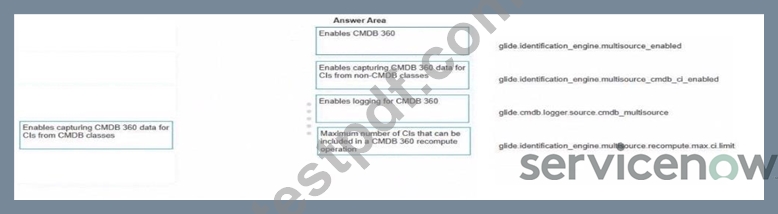
Explanation:
In ServiceNow, CMDB 360 / Multisource CMDB extends the Identification and Reconciliation Engine (IRE) to support multi-source visibility, reconciliation, and confidence scoring.
Configuration is controlled through system properties, each enabling a specific capability.
glide.identification_engine.multisource_enabled is the master switch that activates CMDB 360 functionality.
glide.identification_engine.multisource_cmdb_ci_enabled allows CMDB 360 to collect and evaluate data specifically from CMDB CI classes.
glide.cmdb.logger.source.cmdb_multisource enables detailed logging for troubleshooting multisource ingestion and reconciliation.
glide.identification_engine.multisource_recompute.max_ci_limit protects performance by limiting how many CIs can be processed during a recompute operation.
Capturing CMDB 360 data from non-CMDB classes is not supported, which is why no property applies to that option.
This mapping aligns with Data Foundations and CMDB governance best practices, ensuring CMDB 360 is enabled safely, transparently, and at scale.
NEW QUESTION # 66
A CMDB Administrator is implementing Vulnerability Response or Security Incident Response and needs to ensure customers have enough context to estimate risk and set task priorities.
Which Get Well Playbook from the CSDM Data Foundations Dashboard helps with this?
- A. Application Services with Business Application Relationships
- B. Named Product Models without Product Owners
- C. Percentage of Custom Status Values for CI Life Cycle Stages
- D. Locations without a Parent Location
Answer: A
Explanation:
In ServiceNow, Vulnerability Response and Security Incident Response rely heavily on business context to accurately assess risk, prioritize remediation tasks, and communicate impact to stakeholders. From a CSDM (Common Service Data Model) perspective, this context is primarily delivered through properly modeled relationships between Application Services and Business Applications.
The "Application Services with Business Application Relationships" Get Well Playbook directly addresses this requirement. In CSDM, Application Services represent the technical, deployable services that run in the environment, while Business Applications represent the logical applications that support business capabilities. When these two are correctly related, security teams can clearly understand which business processes, customers, and revenue streams are affected by a vulnerability or security incident.
Without this relationship, vulnerabilities may still be detected, but they lack meaningful prioritization. For example, a critical vulnerability on an application service supporting a revenue- generating or customer-facing business application should be addressed far more urgently than one tied to a low-impact internal tool. This relationship is what enables risk-based prioritization, rather than purely technical severity-based prioritization.
NEW QUESTION # 67
Which is a purpose or requirement ofCMDB Data Managerin ServiceNow?
- A. Automates the enforcement of relationship rules between CIs in the CMDB
- B. Automates the archival and deletion of records based on retention policies
- C. Encrypts archived records for enhanced security
Answer: B
Explanation:
TheCMDB Data Managercapability inServiceNowis designed to supportCMDB governance, specifically arounddata lifecycle management. Its primary purpose is to ensure that CI records areretained, archived, and deletedin accordance with definedretention policies, regulatory requirements, and organizational data governance standards.
As CMDBs mature, they naturally accumulate obsolete, retired, or decommissioned CIs. If these records are not properly managed, they negatively impact CMDB health, reporting accuracy, discovery reconciliation, and performance. CMDB Data Manager addresses this byautomating the archival and deletion of recordsonce lifecycle conditions and retention thresholds are met.
Option A is incorrect because encryption of archived records is handled by platform-level security and data protection features, not CMDB Data Manager. Option B is also incorrect becauserelationship rule enforcementis managed through CSDM guidance, CMDB relationship rules, and identification/reconciliation logic-not by CMDB Data Manager.
By automating retention-based archival and cleanup, CMDB Data Manager helps organizations maintain alean, compliant, and high-quality CMDB, which directly supports CMDB Health metrics such as correctness and compliance.
Therefore, the correct and verified answer isOption C.
NEW QUESTION # 68
A developer bypasses IRE by inserting directly into cmdb_ci via script. What risk does this introduce?
- A. Asset misalignment
- B. Missing ACLs
- C. Duplicate CI creation and reconciliation conflicts
- D. Performance degradation
Answer: C
Explanation:
Bypassing IRE risks duplicates because identification and reconciliation controls are not enforced.
NEW QUESTION # 69
What is the recommended way to model shared middleware supporting multiple business services?
- A. Direct CI relationships to business services
- B. Store as an asset only
- C. Create an Application Service representing middleware
- D. Create a custom CI without relationships
Answer: C
Explanation:
Middleware should be modeled as an Application Service to support proper service abstraction and dependency mapping.
NEW QUESTION # 70
A CMDB Administrator identifies duplicate CIs. One was created by a manual import, and the other was created by automated discovery. The discovered CI has the latest IP address, while the manually imported CI has an accurate relationship to a critical business application.
How does the Administrator use theDuplicate CI Remediatorto resolve this issue?
- A. Retain the manually imported CI and delete the discovered CI
- B. Retain the discovered CI and delete the manually imported CI
- C. Retain the discovered CI, but merge the relationship from the manually imported CI
- D. Merge the two CIs automatically, retaining all attributes from the discovered CI
Answer: C
Explanation:
InServiceNow, theDuplicate CI Remediatoris designed to resolve duplicate records while preserving themost authoritative datafrom each source. Data Foundations guidance clearly states thatautomated discovery is the system of record for technical attributes, such as IP address, hostname, and operational status, while manually maintained records often containvaluable business context, such as relationships to business applications or services.
In this scenario, the discovered CI contains the most accurate and up-to-datetechnical data, making it the correct CI to retain as the primary record. However, the manually imported CI has acritical relationship to a business application, which is essential for impact analysis, incident prioritization, and CSDM alignment.
Deleting this CI without preserving the relationship would result in loss of business context and reduced CMDB value.
The Duplicate CI Remediator supportsselective merging, allowing administrators to retain one CI while merging specific attributes or relationships from the duplicate. Option C reflects this best practice by retaining the discovered CI and merging the relationship from the manually imported CI, ensuring both technical accuracy and business relevance are preserved.
Options A and D would result in the loss of important relationship data, while Option B would discard the discovered CI, violating the principle that discovery should be the authoritative source for technical attributes.
Therefore,Option Cis the correct and Data Foundations-aligned answer.
NEW QUESTION # 71
......
ServiceNow CIS-DF Exam Syllabus Topics:
| Topic | Details |
|---|---|
| Topic 1 |
|
| Topic 2 |
|
| Topic 3 |
|
| Topic 4 |
|
| Topic 5 |
|
Updated CIS-DF Dumps Questions Are Available For Passing ServiceNow Exam: https://pass4sure.testpdf.com/CIS-DF-practice-test.html
